Guides
Winter camping and extreme cold: what changes
Below freezing, it isn't the sleeping bag that decides the night: ground insulation, gas, condensation, clothing and water all behave differently.
5 min read
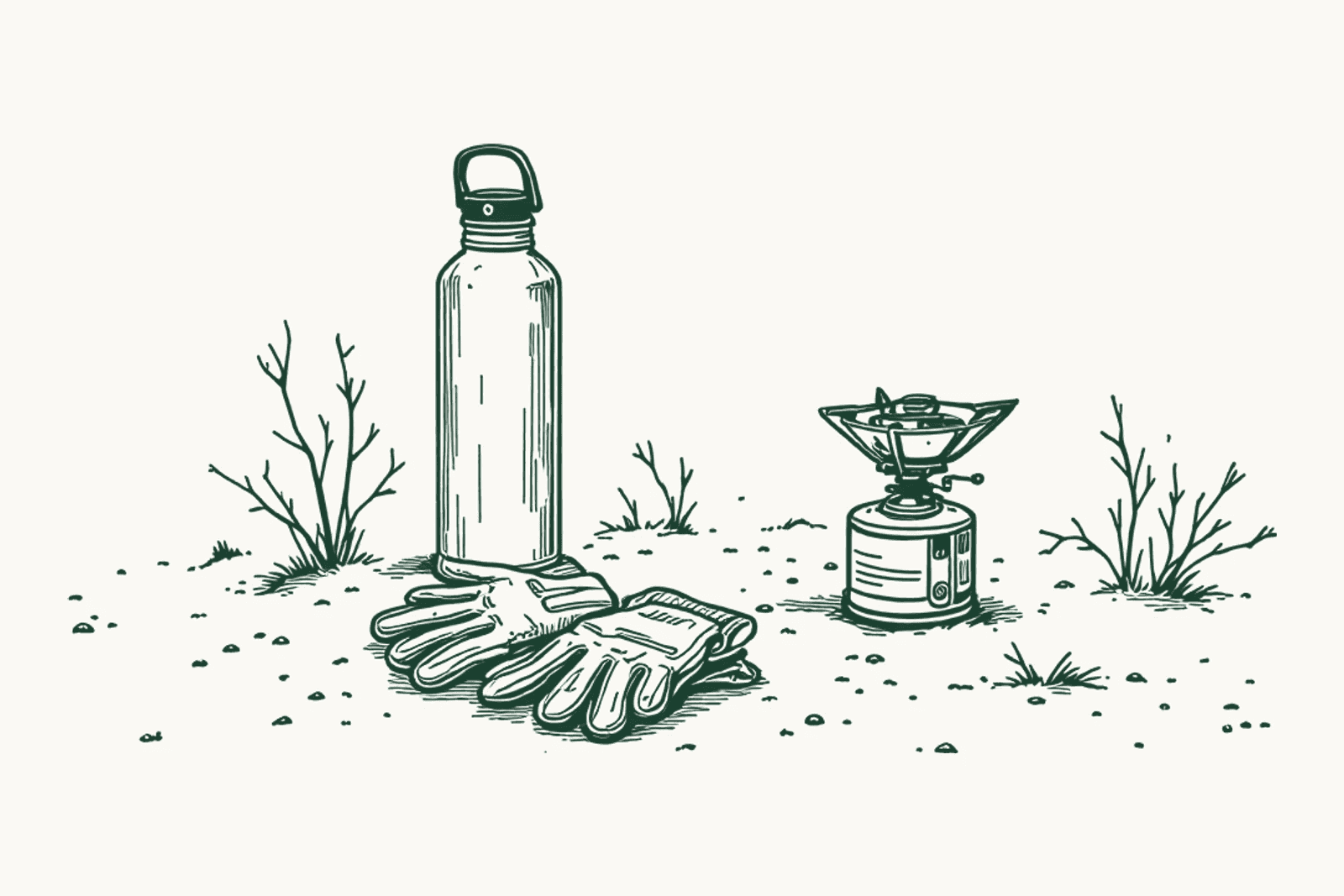
At 8°C, a good sleeping bag is nearly enough on its own for a decent night. Below freezing, the bag stops deciding it; the ground takes over. Squashed under the sleeper’s weight, insulating fill loses most of its power exactly where it is needed most, and heat drains into the earth by conduction far faster than it escapes into the air. A bag rated to −5°C on a thin mat gives a colder night than a bag rated to 0°C on a properly insulating one. Condensation, gas, clothing and water all behave differently below freezing too, rarely as intuition suggests.
Ground insulation, not a warmer bag
The figure that matters under the tent is not the bag’s comfort rating, but the mat’s R-value — its resistance to heat flow. Under 2 suits a dry summer night; between 2 and 4 covers most three-season nights; below freezing, aiming above 4 stops being a comfort option and becomes the rule. R-values add up roughly: a closed-cell foam mat under an underpowered inflatable recovers much of the shortfall, for less than a new mat costs. See air mattress or camp bed for the detail, and how to choose a sleeping bag for the bag itself, chosen by comfort rating, never the extreme figure.
When condensation turns to frost
A night shared by two people releases several hundred millilitres of water vapour from breathing alone. That vapour condenses wherever it meets a surface colder than itself — a flysheet, or the inner wall of a single-skin shelter — once that surface drops below the dew point, which happens quickly when the outside air is already near zero. Below freezing, the condensed water turns straight into frost, flaking off as the fabric moves or warms in the morning, and landing back on the sleeping bag.
Closing every vent to keep warmth in makes this worse: the less air moves, the thicker the frost grows overnight. This is the counterintuitive part — in serious cold, a little ventilation costs a few degrees but saves you from sleeping under a layer of ice. A well-ventilated double-skin tent limits this far better than a sealed single-skin one, a point covered in how to choose a camping tent.
The gas that loses its pressure
A gas canister works because its contents vaporise under pressure to feed the burner. Butane stops vaporising properly around 0°C, and real pressure already drops noticeably below 5°C; the effect worsens with use, since evaporation itself absorbs heat and cools the canister further. A canister that held a strong flame the evening before at 8°C can refuse to light the following night, with no warning beforehand.
Propane copes with cold far better — it keeps vaporising down to around −42°C — which is why “winter” canisters are enriched with propane rather than pure butane: check the label, not the marketing name. Warming the canister against the body, using an inverted-canister stove that draws liquid gas, or switching to a petrol or multi-fuel stove all limit the problem, covered in how to choose a camping stove.
Dressing without ever sweating
The three-layer principle — technical against the skin, insulating, windproof and waterproof — holds all year, but winter no longer forgives mistakes. The most common one happens on the walk in, not at camp. Overdressed, you sweat; the moisture soaks the layers closest to the skin, and the moment effort stops — pitching camp, a break, waiting around — it pulls heat away far faster than it evaporated while you were moving. The body ends up cooling from the inside, in clothing that is already damp, at exactly the moment it is moving least.
The correction happens before sweating starts: set off slightly chilly for the first ten minutes, shed a layer as effort rises, put it back on the moment you stop. Avoiding cotton against the skin is good practice all year; below freezing, it becomes a rule with no exceptions.
Water that freezes, and filters that crack
A full bottle freezes from the top down, where it meets the air, and the cap gets trapped in ice before the rest of the contents do — storing it neck-down keeps the opening usable longer. Slipped into the sleeping bag overnight, a bottle draws on the sleeper’s own warmth and stays liquid well past the point it would outside.
Membrane water filters are more fragile than everyday use suggests: residual water trapped in the pores freezes, expands and cracks the membrane invisibly — the filter looks intact but afterwards lets through exactly what it was meant to stop. Treat a filter that has frozen even once as suspect, not as working. Carry it against the body rather than in an outer pocket, or purge it completely before any exposure to the cold. Failing that, boiling remains the most reliable way to purify water in serious cold.
Two real risks, without the drama
Two dangers deserve to be named plainly: they kill for real, not only in extreme conditions. Carbon monoxide is colourless and odourless. A stove lit inside a closed shelter — a zipped tent, a vestibule sealed “just long enough to boil water” — uses up the available oxygen and releases enough of it to be fatal within a few dozen minutes, with no warning before drowsiness sets in. The rule has no exceptions: never a flame in an enclosed space, even briefly.
Hypothermia does not depend only on the number on a forecast: wind and dampness strip heat from the body far faster than still, dry air at the same reading, and no single figure sums up that effect for every situation. The useful preparation is not a threshold to memorise, but a forecast checked for the actual place and date, with a fallback plan if conditions worsen.
What cannot be improvised
A properly insulating mat, a canister matched to the forecast temperature, and a sleeping bag genuinely sized for the trip cannot be fixed by any trick on the day — these are choices made before leaving, not on site. Other details can be patched in the field: spare clothing tucked under the hips to offset a marginal mat, a canister warmed against the body, a bottle insulated inside a spare sock. Insulation and energy are prepared before departure; extra comfort is improvised on the spot.
Frequently asked questions
- Do you need a warmer sleeping bag for winter camping?
- Not only that. Below freezing, ground insulation matters at least as much as the bag's comfort rating: a mat with an R-value above 4 changes the night more than a bag that is a few degrees warmer. Choose the two together, never one without the other.
- Why does a gas stove stop working in extreme cold?
- Because the butane inside stops vaporising properly around 0°C, and the canister keeps cooling further as it is used. A propane-enriched mix, a canister warmed against the body, or a petrol stove all avoid the failure.
- Can you heat water inside the tent to warm up?
- No, never in a fully enclosed space. A lit stove uses up the oxygen there and releases carbon monoxide, colourless and odourless, in a fatal quantity within a few dozen minutes. Always cook with at least one vent open, or outside the shelter.