Sleeping
How to choose a sleeping bag for camping
Choosing a sleeping bag: understanding comfort, limit and extreme ratings, comparing down and synthetic, and finding the right shape and size.
4 min read
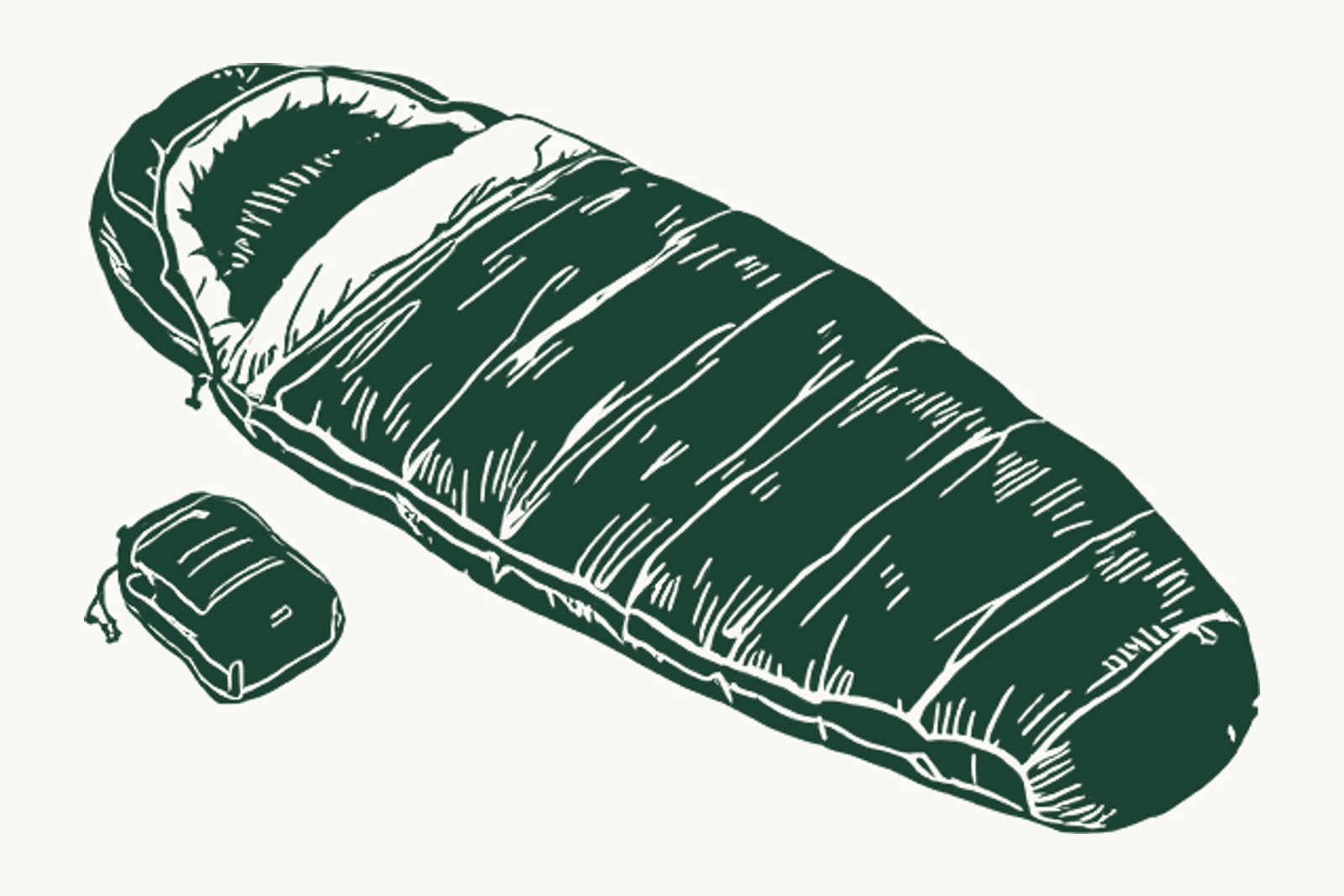
A sleeping bag is chosen first on its comfort temperature, then on its fill, its shape and its size. For summer camping in temperate Europe, a bag rated around 10 °C comfort is enough in the lowlands; reckon on 5 °C or lower at altitude and in the shoulder seasons. And keep in mind the least intuitive point of the whole subject: an excellent bag on a poor mat gives a cold night.
Reading the three printed temperatures
The European standard EN 13537, replaced by ISO 23537, requires a standardised test on a heated mannequin. It produces three figures, only one of which is usable day to day.
| Figure | What it describes | Use |
|---|---|---|
| Comfort | A standard woman sleeps relaxed, without feeling cold | The only one to use |
| Limit | A standard man sleeps curled up, on the edge of discomfort | Occasional margin |
| Extreme | Six hours of survival, risk of hypothermia | No practical use |
The gap between comfort and extreme often exceeds 15 °C. That is exactly the gap exploited by product pages advertising “−10 °C” on a bag whose real comfort rating is +5 °C.
Two corrections to apply to the printed figure: the standard assumes a sleeper in long underwear on an insulating mat, and individual metabolism varies widely. If you sleep cold, take 5 °C off the stated value.
Down or synthetic
Down (duck or goose) offers the best warmth-to-weight ratio and compresses remarkably. Its loft, expressed in cuin (from 550 to over 850), measures the volume an ounce of down occupies: the higher it is, the warmer the bag at a given weight. Its limits: it loses most of its insulating power once wet, dries slowly and costs a great deal.
Synthetic is heavier and bulkier for the same warmth, but keeps part of its insulation when damp, dries quickly, washes without special care and costs two to three times less.
The split is clear: down for hiking and bivouac, where every gram and litre counts; synthetic for car camping, where neither weight nor volume is limiting.
Shape
The mummy follows the body and reduces the volume of air to be warmed. It is the most thermally efficient and lightest shape, but it constrains movement.
The rectangular bag gives great freedom and opens out flat as a quilt. It is markedly less efficient in cool weather and bulkier, which suits summer car camping perfectly.
The tapered rectangle is a common and sensible compromise.
Double bags, zipped together in pairs, are appealing but insulate less well: two individual bags joined by their zips remain more efficient.
Size matters as much as temperature
A bag that is too large leaves a volume of air the body must warm all night; one that is too short compresses the fill at the feet and creates a cold spot. Check the maximum user height stated, not the external length of the bag, and note that most manufacturers offer short and long versions. For children, a junior bag is far more effective than an adult one, for exactly this reason.
The decisive point: insulation from the ground
This is the most common and most expensive mistake. Under body weight, the fill of the bag is crushed to a few millimetres and stops insulating altogether. Heat then leaves towards the ground by conduction, far faster than into the air.
Insulation therefore comes from the mat, measured by its R-value:
- R under 2: summer nights on dry ground;
- R 2 to 4: three seasons, ordinary use;
- R over 4: cold ground, late season, mountains.
Put another way: between a 0 °C comfort bag on a thin foam pad and a 10 °C comfort bag on a good self-inflating mat, the second gives the better night at 8 °C. The subject is covered in air mattress or camp bed.
The details that make the difference
- The draught collar, an insulated baffle at shoulder level, stops warm air escaping. It is the detail that separates a summer bag from a genuine three-season one.
- The zip baffle along the zip removes the thermal bridge of the slider.
- An adjustable hood: the head accounts for a significant share of heat loss.
- A compression sack for carrying, and above all a large storage sack for home.
Using it well and keeping it
Three habits are worth several degrees:
- Air the bag on arrival at camp, so it recovers its loft.
- Get in warm. A sleeping bag does not produce heat, it keeps yours. Climbing in frozen does not work.
- Do not over-dress. Several layers compress the fill against the body and reduce insulation.
For storage, never keep a bag compressed. The fill loses its loft permanently. Hang it, or keep it in a large mesh sack, always perfectly dry. A silk or cotton liner postpones washing considerably, and washing is the most aggressive thing you can do to any fill.
Once the sleep system is settled, the rest of the kit is in our complete checklist, and the shelter in how to choose a camping tent.
Frequently asked questions
- What sleeping bag temperature for summer in temperate Europe?
- A comfort rating of 10 °C suits lowlands and the coast in July and August. As soon as you camp at altitude or late in the season, aim for 5 °C or lower: mountain nights regularly drop below 8 °C even in midsummer.
- Comfort rating or limit rating?
- Comfort, without exception for leisure use. The limit rating describes a sleeper curled up on the edge of discomfort, and the extreme rating measures only a few hours of survival with a risk of hypothermia.
- Down or synthetic?
- Down for trips where weight and packed size decide, provided you can keep it dry. Synthetic for car camping, damp conditions, hire fleets and every use where price matters more than grams.
- How do you wash a sleeping bag?
- By hand, or in a machine on a low spin, with a suitable detergent — down-specific for down. Drying is the critical stage: several hours in a tumble dryer on low with dryer balls to break up the clumps of fill.