Cooking
How to choose a camping stove
Comparing camping stoves: gas canister, multi-fuel, alcohol, wood and double burner. Fuel autonomy, cold weather, weight and safe use.
4 min read
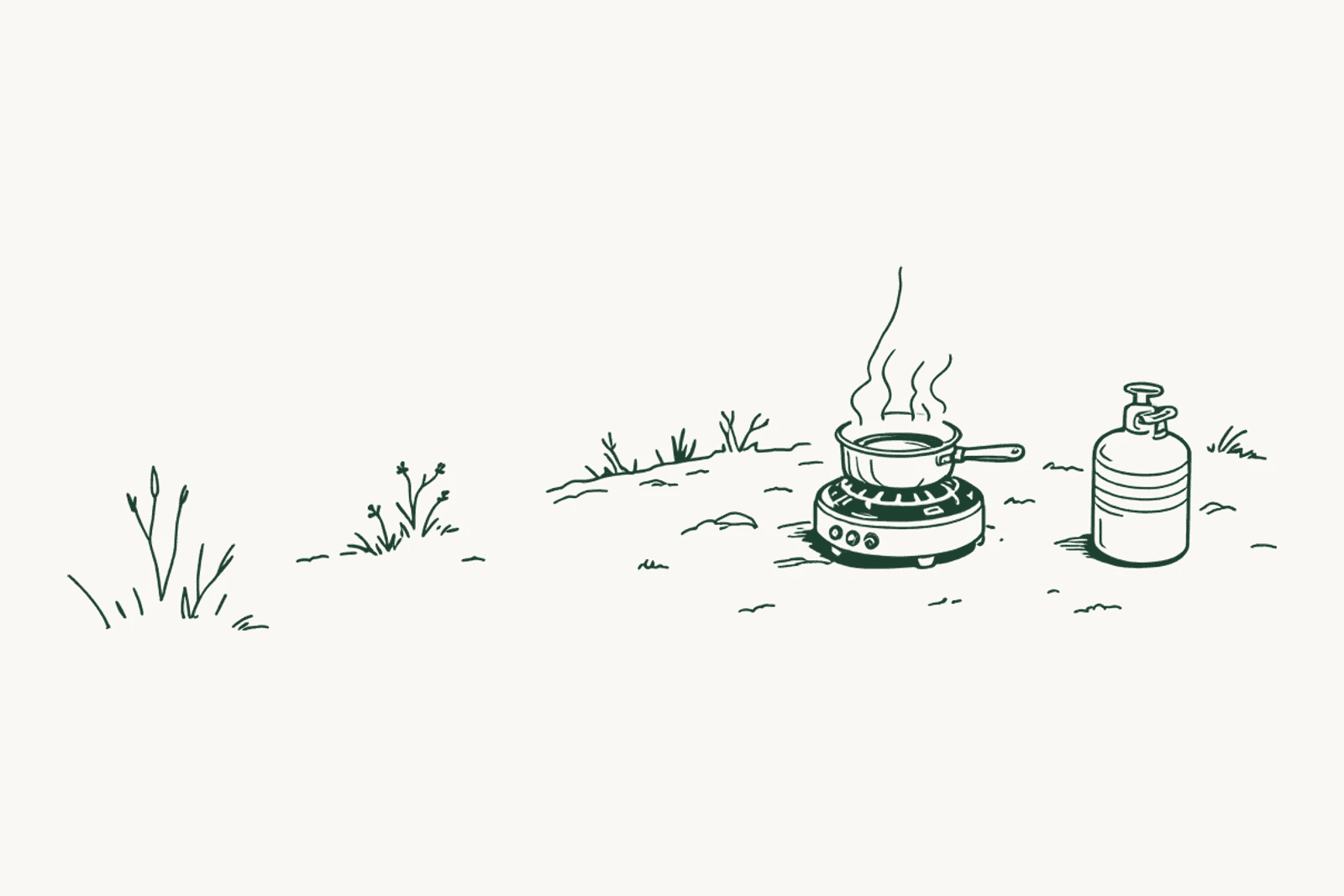
For holiday camping in temperate Europe, the valve-type gas canister stove is the default: instant lighting, fine flame control, no maintenance, and canisters available everywhere. The other technologies answer specific needs — deep cold, distant travel, complete self-sufficiency — that a summer trip never encounters.
The five families
The gas canister stove
It runs on a pressurised butane-propane mix. Two formats coexist: the valve canister, with a standard thread, which unscrews even part-used and is sold across Europe, and the pierceable canister, cheaper but locked to the stove until empty. Always prefer the valve type.
Then two architectures. The canister-top stove, screwed straight on, is ultralight (50 to 150 g) and ideal for hiking, but unstable as soon as you put a large pot on it. The remote stove, linked by a hose, is more stable, takes bigger pans, and lets you invert the canister to feed liquid fuel — which markedly improves cold-weather performance.
Its limit is thermal. Below 5 °C butane vaporises poorly and output drops; below 0 °C it practically stops. The canister seems empty while it is full. Propane-rich mixes and inverted-flow stoves push that threshold back.
The liquid-fuel or multi-fuel stove
It burns dedicated fuel, sometimes paraffin or diesel. It works in any cold, with constant output down to the last drop, and its fuel can be found anywhere in the world — the decisive argument for long-distance travel.
The trade-offs: preheating before every use, regular maintenance — cleaning the jet, replacing seals — more weight and noisy running. It is a tool for someone willing to service it.
The alcohol stove
A simple burner, often with no moving parts, fed with methylated spirit. Silent, indestructible, very light and very cheap. In exchange it heats slowly, barely adjusts, and its flame is almost invisible in daylight, which demands particular care. A windshield is essential.
The wood stove
It burns twigs gathered on the spot: total self-sufficiency, no fuel to carry. In practice it needs dry wood, blackens pans, demands constant feeding, and remains banned in many areas during fire-risk periods. A niche solution.
The double burner
The car-camping format: two burners under a windshield lid, fed by a gas bottle or a large canister. It lets you genuinely cook — a pan and a pot at once. Heavy and bulky, it only makes sense when the kit travels by car.
The decision table
| Use | Stove |
|---|---|
| Car camping, family | Double burner, or remote gas |
| Car camping, two people | Remote gas canister stove |
| Hiking, summer bivouac | Canister-top gas, or alcohol |
| Hiking in cold, at altitude | Inverted-flow gas, or liquid fuel |
| Long-distance travel outside Europe | Multi-fuel |
Working out your autonomy
This is the most useful calculation before leaving. A 230 g canister brings between 8 and 12 litres of water to the boil depending on the stove, the wind and the starting temperature. For two people cooking simply — a hot drink morning and evening, one cooked meal a day — that covers four to five days.
Three things cut that sharply: wind, which can double consumption without a windshield; cold, which raises the energy needed and degrades vaporisation; and altitude, where water boils lower but food cooks more slowly.
Since nothing indicates how much is left in a canister, the rule is simple: always carry a spare. A practical trick is to weigh an empty canister once and for all, then weigh yours before each trip.
Safety: four rules
- Never inside a tent, never in a closed vehicle. Carbon monoxide is odourless and kills within minutes. Cook outside, or under an awning open on at least two sides.
- On a flat, stable surface, away from fabric, dry grass and low branches.
- Keep canisters in the shade. A canister in the sun rises in pressure. Store upright, cool, never in a boot in high summer.
- Check the valve seal every time you fit it, and test for leaks with soapy water at the slightest doubt.
Empty canisters do not go in household waste: take them to a recycling centre, pierced first if the model allows.
The accessories that change the outcome
- The windshield, the best value accessory there is. It can halve boiling time. Never fully enclose a canister inside one, though.
- The pan lid, which cuts time and fuel by about a third.
- Heat-exchanger pots, finned underneath, which noticeably improve efficiency for modest extra weight.
- A built-in piezo igniter, convenient but unreliable over time: always keep a lighter and matches as backup.
Once the stove is settled, there is the rest of the cooking area to organise: see how to organise a camp kitchen and the complete checklist.
Frequently asked questions
- How long does a 230 g gas canister last?
- About four to five days for two people cooking simply, or 8 to 12 litres of water brought to the boil depending on the stove, the wind and the temperature. Always carry a spare: nothing tells you how much is left before it runs out.
- Can you use a stove inside a tent?
- No. Combustion in an enclosed space produces carbon monoxide, which is odourless and lethal, and the fire risk on synthetic fabric is immediate. Cook outside, or under an awning open on at least two sides.
- What is the difference between a valve canister and a pierceable one?
- A valve canister, with a standard thread, unscrews at any time including part-used, and is available across Europe. A pierceable canister is cheaper but stays attached to the stove until completely empty. Choose the valve type.
- Which stove for cold or winter use?
- A liquid-fuel stove, or a gas stove with a propane-rich mix and an inverted-flow preheat system. Pure butane practically stops vaporising below 0 °C: the canister feels empty while it is still full.