Guides
How to pack the car properly for a camping trip
Packing a car for camping is a weight problem: how to distribute the load, respect your payload limit, and pack in the right order.
6 min read
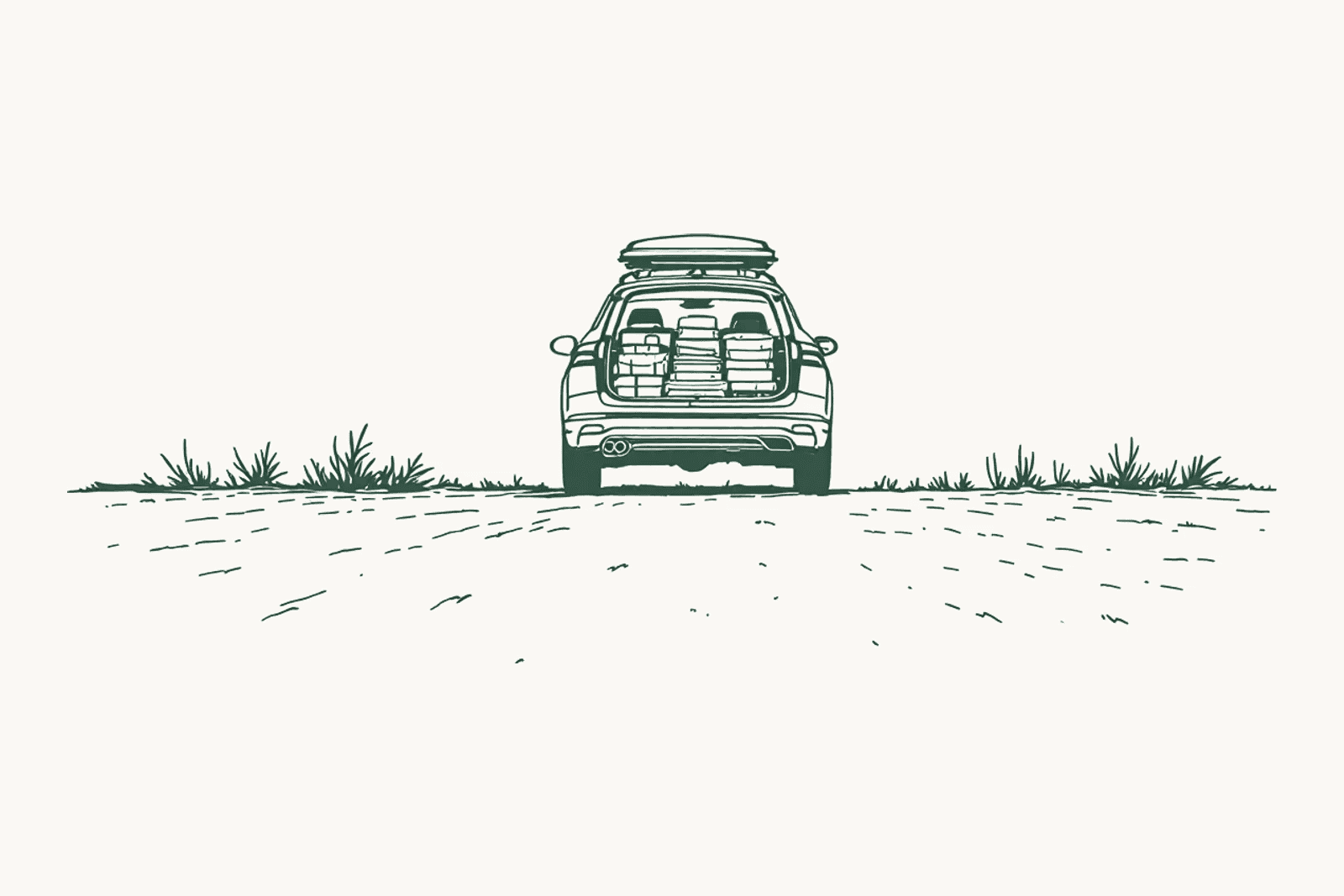
A full cool box, a family tent, bikes and a roof box: the weight adds up fast, and few drivers know where their own car’s legal limit actually sits. The rule is short. Load heavy items low and against the back seats rather than behind the rear axle. Pack whatever you need on arrival last. And check the car’s real payload on its registration document, because a family camping load — four passengers, a roof box, a full cool box — reaches that limit more easily than most people think.
Weight and the physics of the boot
A heavy item placed high or far back shifts the car’s centre of gravity upwards and rearwards. In normal driving, this makes no noticeable difference. In an emergency stop or a sudden swerve, it does: weight pushed towards the rear reduces the load on the front wheels, the ones doing the braking and the steering, and it amplifies how much the body of the car pitches and rolls. The car responds later, and less predictably.
The fix needs no calculation. Put the heaviest items — a full cool box, water containers, boxes of crockery — at the bottom of the boot, against the seat backs, ideally over or ahead of the rear axle. Light, bulky gear such as a folding table or chairs comes next; the guide on choosing a camping table and chairs points out that this furniture folds flat precisely because it makes good filler for the sides of a boot without upsetting the balance of the load.
The payload is a real number, not a guess
Every car has a maximum authorised laden mass, printed on its registration document. Passengers, luggage, a full tank and accessories all count towards it — something many drivers never check until the boot lid will not close. The difference between the kerb weight and that maximum is the real payload available, and it shrinks quickly: four adults already account for several hundred kilograms before the boot is even opened.
A roof box carries its own maximum load, stated in its manual; the roof bars underneath it almost always carry a lower limit still. The roof is the most tempting place on the car to gain extra volume, and it is also the most constrained: you work to whichever limit is lower, never the higher one. The guide on family camping gear gives a sense of just how much volume a trip for four or five people involves, and therefore how tempting it is to add a roof box without checking that figure first.
Loose objects become projectiles
Anything not secured behind the rear seats turns into a projectile under heavy braking. A 15 kg cool box travelling at 50 km/h does not stop just because the car stops; it carries on, with all the energy it built up. That is the reasoning behind fitting a cargo net or load bar between the boot and the cabin in estates and people carriers, and behind the simple rule of never stacking gear above the line of the seat backs when there is no physical barrier to hold it in place.
Loading order, or packing in reverse
The principle is easy to state and easy to forget under the pressure of leaving: whatever comes out first goes in last. The tent, the mallet, a bag of clothes for the first evening, water and something to eat should all stay accessible without unpacking the whole boot in the car park. The classic mistake is burying the tent under the suitcases, when it is the thing you need within the first ten minutes of arriving.
To build that order without thinking it through every time, work from a list you have already written once. The complete camping gear checklist and the shorter guide on what gear you actually need for camping give the base to organise the loading around.
| Order | Item | Why |
|---|---|---|
| 1 (bottom of boot) | Heavy items: cool box, water, crockery | Stability, low and forward position |
| 2 | Folding furniture, cooking gear | Medium volume, rigid |
| 3 | Sleeping bags, mats, clothing | Light, fills gaps |
| 4 (loaded last) | Tent, mallet, “first night” bag, water, snacks | First thing you need on arrival |
The cool box belongs in the cabin, not a black boot in August
A cool box copes far better travelling in the cabin than shut in a dark boot in the middle of summer, where the temperature climbs much faster than inside the car itself. If it is electric, check beforehand whether the socket stays live with the engine off — on many cars the 12 V socket cuts out automatically to protect the battery, which matters a great deal on a trip with long stops. The rest of the kitchen set-up is covered in how to organise a camp kitchen.
What stays in the cabin, not the boot
A handful of items need to stay within reach of the driver or front passenger, never buried in the boot:
- vehicle documents and identification
- any ongoing medication
- phones and their chargers
- a bottle of water
- the reflective jacket and warning triangle
In France, these last two must be reachable without leaving the vehicle or opening the boot — a jacket packed inside a suitcase at the bottom of the boot is no use at all if you need to stop on the hard shoulder.
Roof boxes and towing: what changes
A roof box or a trailer adds height or length that is easy to forget in front of a low car park barrier or a covered entrance — a common and expensive mistake. Both also increase fuel consumption, lengthen braking distances because of the extra mass, and make the car noticeably more sensitive to crosswinds, particularly on exposed bridges or when overtaking a lorry. None of this rules out using one; it simply means adjusting speed and following distance accordingly.
Before you set off
The check almost nobody makes, and the one that matters most, concerns the tyres. A loaded car needs a different pressure to an empty one: the sticker on the driver’s door frame or the vehicle handbook gives both figures, unladen and laden. Check fluid levels too — oil, coolant, screen wash — and confirm the spare wheel or puncture repair kit is actually usable, before you leave rather than after finding a flat tyre on a motorway services forecourt.
What to take away
A well-thought-out load takes no longer to pack than a random one; it just saves you from unpacking the whole boot in a campsite car park to find the tent. Load heavy and low, keep the first ten minutes’ worth of gear within easy reach, and spend two minutes comparing your actual load against the payload printed on the registration document. It is the cheapest check in the whole trip.
Frequently asked questions
- Where do I find my car's exact payload?
- On the vehicle's registration document (V5C in the UK), which states the kerb weight and the gross vehicle weight; the manufacturer's plate under the bonnet or on the door pillar gives the same figures. The difference between the two is what you can add in passengers, luggage and accessories — roof box included.
- Does an empty roof box still increase fuel consumption?
- Yes, even empty: it is the drag it creates, not just what is inside it, that costs fuel. How much depends on speed and the box's shape, but the effect exists as soon as it is fitted. Take it off between trips rather than leaving it mounted for the whole season.
- Should tyre pressures change for a loaded car?
- Yes. Most cars show two figures on the door-frame sticker or in the handbook: one for normal or unladen use, one for full load. A family camping trip with a roof box almost always falls into the second category, and it is the check most drivers skip.