Guides
Where Did Camping Come From, and Why Did It Take Hold in France?
Camping began in England with a cyclist; it took hold in France through clubs, the 1936 paid holidays, and the arrival of the car.
5 min read
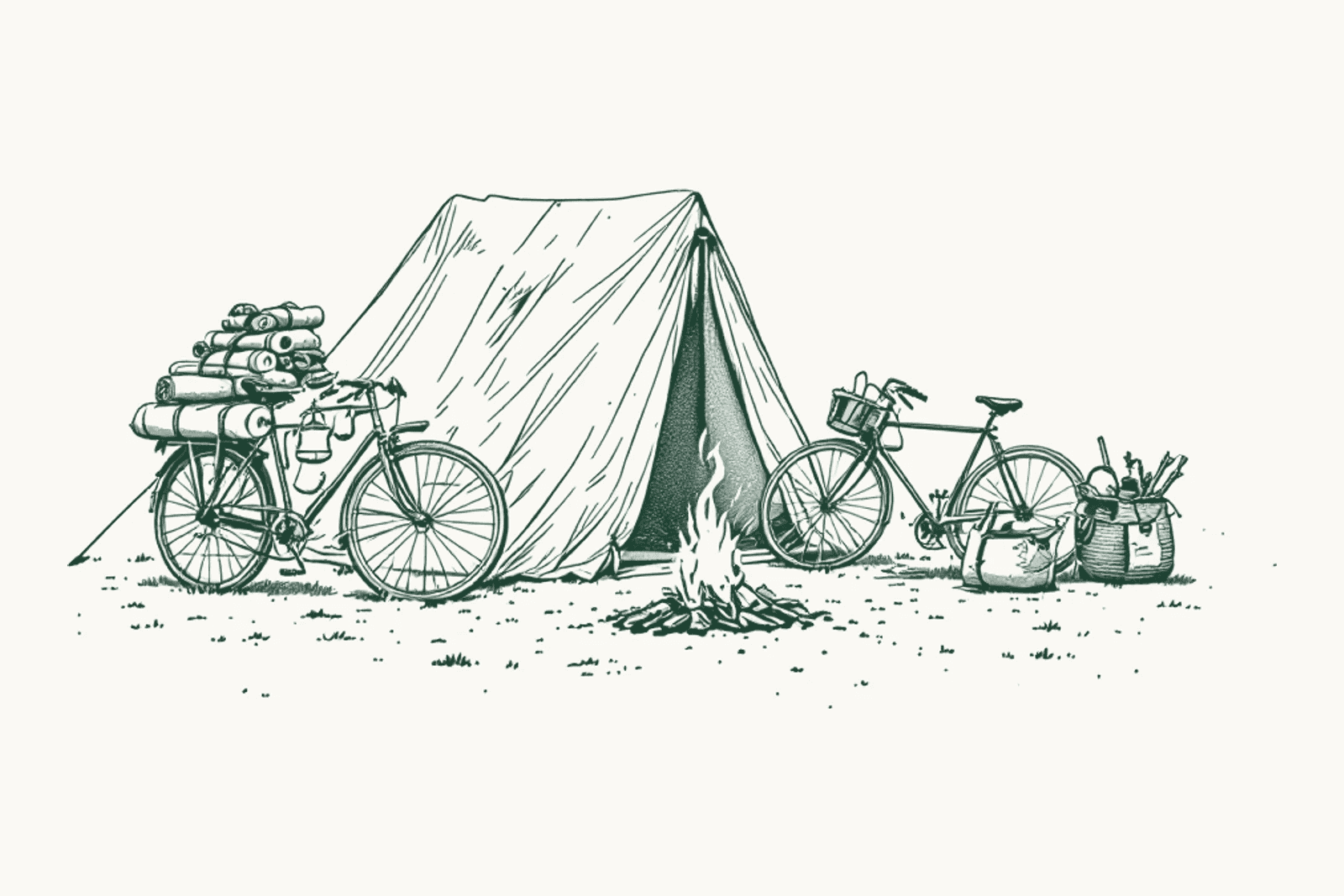
A tent that folds flat in thirty seconds, a mattress that packs into a bottle, a stove that weighs two hundred grams: none of that happened by accident. Camping as a deliberate leisure pursuit, as opposed to sleeping rough out of necessity, began in England at the turn of the twentieth century, driven by a cyclist who wanted to travel light. It took a good three decades to become a mass pursuit in France, waiting on paid holidays and then the family car to change who could go, and how.
An English cyclist invents a pursuit
Camping as an organised leisure activity is usually traced to one figure: Thomas Hiram Holding, an English cyclist who had crossed the American plains by wagon as a boy. As an adult, he applied the same idea to his own modes of travel — first the bicycle, then the canoe — and took up camping for the pleasure of moving light rather than out of necessity. In 1901 he founded an association of cycle campers; in 1908 he published The Camper’s Handbook, a manual that set out, for the first time, the case for equipment designed around the pursuit itself rather than mere survival. The association he founded still exists today, in a later form.
The bicycle’s constraint, the mother of light gear
That biographical detail matters more than it might seem: it was the bicycle, not the idea of camping itself, that shaped the equipment. A cyclist can only carry what fits on a rack, and every superfluous ounce is paid for in miles. Canvas got lighter, poles got shorter, bedding learned to fold flat. The same constraint now drives bike touring gear and the modern bivouac gear list: a pack, a tent, a stove, nothing that cannot justify its own weight. Lightweight camping is not a recent trend; it is the original form the pursuit took.
French clubs pick up the movement
In France, the idea travelled through the same networks as elsewhere in Europe at the time: the touring and cycling clubs of the late nineteenth century, the Touring Club de France chief among them, which encouraged members to explore the country under their own steam rather than by organised rail travel. A French camping club followed in the earliest years of the twentieth century, built on the same associative principle as its British counterpart: pool experience, spread good practice, and popularise a still rare piece of equipment. At this stage the pursuit remained a minority interest, largely male, open mostly to those with the time and the means to own a decent bicycle.
1936: paid holidays open camping to families
The real shift did not come from a technical invention but from a law: the introduction of paid holidays in France in 1936. For the first time, millions of employees had a fortnight to spend away from work without a hotel budget to match. Camping became the obvious answer to that equation — a shelter, somewhere to sleep, a box of provisions — and the coast and the mountains opened up to families who had never set foot there before. The equipment itself did not change fundamentally; the basics for putting together what gear you need for camping still resembled those of the cycle tourist decades earlier. What changed was who was going.
After the war: the car changes the scale
The next break came from the car, which spread through French households across the post-war decades. It did not simply add more people to camping; it changed the nature of the equipment, because it removed at a stroke the weight constraint that had shaped the pursuit since Holding’s day. The heavy, bulky cotton-canvas frame tent became a reasonable choice once it travelled in a boot rather than on a rack. Synthetic fabrics and aluminium poles, lighter and more durable than canvas and timber, followed and redefined in turn what counted as a good tent — the criteria covered today in how to choose a camping tent descend directly from that shift. On many sites, the next step is already there: fixed accommodation, put up once and for all, that holidaymakers simply find waiting when they arrive.
Three eras, three ways of camping
The table below sums up what each stage actually changed in what gets carried.
| Era | Mode of travel | What you carry | What the technology allows |
|---|---|---|---|
| Around 1900 | Bicycle or canoe | Tent and bedding on the rack | Light canvas, a folding frame |
| 1936 | Train, bicycle | The same gear, for a new public | Free time, not new technique |
| Post-war | Car | Frame tent, furniture, cool box | Weight and bulk stop mattering |
| Today | Car, plane | Sometimes nothing at all | Fixed accommodation already there |
From gear you carry to gear that waits for you
This trajectory — from equipment carried by a cyclist, to equipment carried by a car, to accommodation that is already there when you arrive — explains why two campers today can have so little in common. One packs a rucksack gram by gram before a bivouac, a direct heir to Holding; another fills a boot without weighing anything, an heir to the post-war motoring boom; a third books a static caravan and brings nothing but a suitcase. None of them is wrong: each is simply extending a different layer of the same history. To work out exactly where your own trip sits, and what it actually means to pack, the camping gear checklist remains the most useful starting point — whichever century you borrow your habits from.
Frequently asked questions
- Who invented camping?
- No one invented it in any strict sense, but the organised pursuit is generally credited to Thomas Hiram Holding, an English cyclist who founded an association of campers in 1901 and published a landmark manual, The Camper's Handbook, in 1908. Before him, sleeping outdoors was mostly a matter of necessity rather than leisure.
- Why did the bicycle matter so much to the history of camping?
- Because it imposes a hard physical limit on what you can carry, in both weight and bulk. That constraint produced the first lightweight tents and compact bedding, long before the car made those savings optional. Modern bike touring runs on exactly the same logic.
- Why did camping take hold in France specifically?
- Two factors combined: touring and cycling clubs active from the late nineteenth century, which spread the practice within a small circle, and then the introduction of paid holidays in 1936, which gave millions of families the time to go away without the means to afford a hotel. Camping became the most accessible form of holiday available to them.
- Has camping gear changed much since the early 1900s?
- The functions have stayed the same — shelter, insulation from the ground, cooking, light — but the materials have changed completely: cotton canvas gave way to coated synthetic fabrics, timber to aluminium and fibreglass. The underlying principle is still Holding's: the gear should serve the pursuit, not the other way round.