Hiking
Bivouac gear list
The bivouac gear list: lightweight shelter, sleep system, minimal cooking, safety and navigation. Reference weights, regulations and good practice.
5 min read
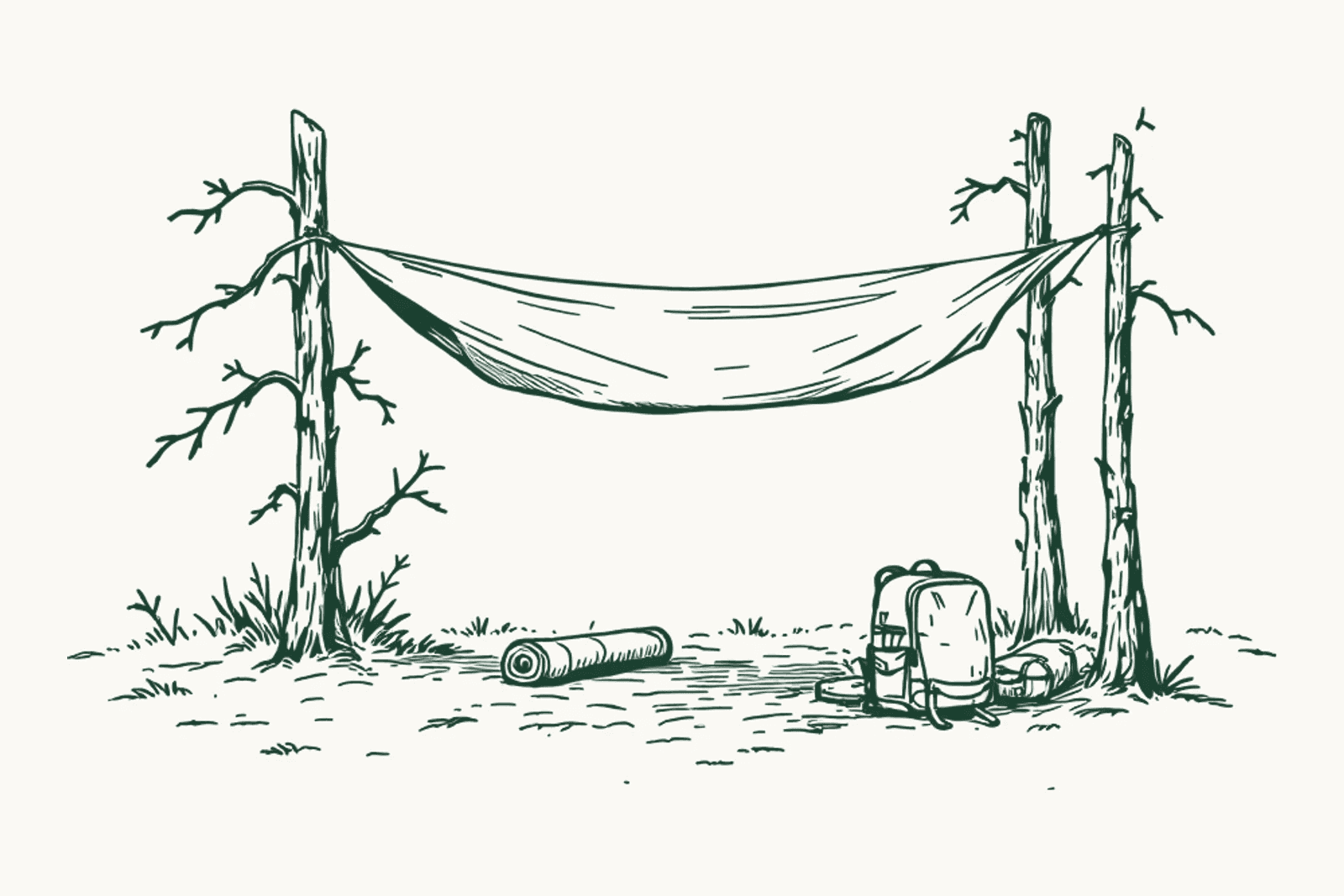
Bivouac kit fits in a 30 to 45 litre pack and comes down to five areas: shelter, sleeping, cooking, safety and navigation. Unlike a holiday under canvas, every item has to justify its weight: you are not adding comfort but removing what will not be used.
A bivouac is a single night, shelter pitched at dusk and struck at dawn. That definition is not merely a convention: it is what separates it legally from wild camping, which is often forbidden where bivouac is tolerated.
Before the list: the weight rule
A reasonable load sits around 20 % of your body weight, water and food included. Beyond that, walking stops being pleasant and the risk of injury rises.
Three items hold most of the mass: the shelter, the sleep system and the pack itself. Working on those three saves kilograms; sorting through small accessories saves a few hundred grams. Always start with the big three.
Shelter
| Option | Indicative weight | Who for |
|---|---|---|
| Freestanding 1-2 person tent | 1.2 to 2.5 kg | Versatile, insect protection |
| Ultralight hiking tent | 700 g to 1.2 kg | Regular walkers |
| Tarp and pegs | 300 to 700 g | Settled weather, experience required |
| Bivvy bag | 200 to 400 g | Sleeping out, emergency backup |
Always add a few spare pegs and 5 metres of cord: cord serves for guying, drying and repairs.
The tarp is the lightest and most versatile answer, but it protects neither from mosquitoes nor from driving rain from the side. It assumes you can pick a sheltered spot and read a forecast.
Sleeping
- A mat with an R-value matched to the season — R 2 minimum in summer, R 3 to 4 in the shoulder seasons. Cold comes from the ground, never from the air.
- A sleeping bag chosen on its comfort temperature, not its extreme rating. In the mountains in summer, nights regularly fall below 8 °C.
- A silk liner, optional, worth a couple of degrees and fewer washes.
- A light hat, the best value item per gram for a cold night.
The criteria are in how to choose a sleeping bag and air mattress or camp bed.
Minimal cooking
- A lightweight canister stove, or an alcohol burner
- A gas canister, checked that it is not nearly empty
- One 700 ml to 1 litre pot with a lid
- A long spoon, which reaches the bottom of a freeze-dried pouch
- A lighter, with matches as backup
- A flexible windshield
- A 1.5 to 2 litre bottle or bladder
- A way to treat water: filter, tablets or boiling
- A bin bag, so everything comes back with you
For a single night, a freeze-dried meal or a dry rehydratable dish avoids washing up and cuts weight. Choosing a stove is covered in how to choose a camping stove.
Clothing
The three-layer principle applies in full: a breathable layer against the skin, an insulating layer, a windproof and waterproof layer.
- Technical base layers, never cotton, which stays damp and chills you
- One warm layer — fleece or a light down jacket
- A waterproof, breathable jacket
- Walking trousers, plus thin leggings for the night
- Walking socks, plus a dry pair kept for sleeping
- Hat, light gloves, neck gaiter
- Walking shoes already broken in
The dry pair of socks kept for the night is a detail that genuinely changes comfort: it is only for sleeping and never leaves the pack during the day.
Safety, navigation, health
- Head torch with spare batteries or a power bank
- Power bank and cable
- Paper map and compass, or offline maps downloaded in advance
- First aid kit: plasters, blister dressings, antiseptic, tape, tick remover, painkiller
- Emergency blanket and whistle
- Sun cream, sunglasses, repellent
- Identity documents and emergency numbers — 112 works across Europe
- A small repair kit: mat patches, cloth tape, needle and thread
Always tell someone your route and your expected return time. It is the most effective safety item there is, and it weighs nothing.
Choosing your spot
Where you stop does more for the quality of the night than the equipment does.
- Flat, free-draining ground, never a hollow or a runoff channel.
- Away from dead trees and unstable branches.
- Off ridges and isolated summits if there is any risk of storms.
- At least 60 metres from watercourses, for the regulations, for flash floods and for damp.
- Sheltered from the prevailing wind, without shutting yourself into a cold hollow.
- Arrive late in the day, leave early, in keeping with what bivouac means.
Regulations in France
Bivouac is not governed by a single national rule. It is forbidden on beaches, in classified sites, within 500 metres of a listed monument, inside drinking-water catchment areas, and on private land without the owner’s permission. Every commune may issue a by-law, and every national park sets its own conditions — often a tolerance between 7 pm and 9 am, away from roads.
Check before you go, with the local authority or the park concerned. A night refused cannot be made up on the spot.
Leaving no trace
The principle is simple, and it is what keeps existing tolerances in place: leave without a trace. Carry out all your waste, organic matter and toilet paper included. Do not light a fire where fires are banned, which today covers most natural areas in dry periods. Move away from water for any washing. And leave the spot exactly as you found it.
For a bike-travel version, where volume constraints replace weight ones, see bike touring gear. And to filter the whole thing down to a bivouac in the season you have in mind, build your kit list.
Frequently asked questions
- What is the difference between bivouac and wild camping?
- Bivouac means a single night in open country, shelter pitched late and struck early, generally from dusk to dawn. Wild camping implies a lasting installation. The distinction is legal: many protected areas tolerate the first and forbid the second.
- What weight should a bivouac pack be?
- For a summer overnight, a complete pack of 7 to 9 kg including water is comfortable, and 5 to 6 kg already counts as a light approach. Above 20 % of your body weight, walking becomes markedly harder.
- Is bivouac allowed in France?
- It depends where. It is forbidden on beaches, in classified sites, within 500 m of a listed monument, inside drinking-water catchment areas, and it is often regulated by local by-law. Each national park sets its own conditions. Always check before you go.
- Do you need a tent to bivouac?
- No. A tarp, a bivvy bag or simply a mat and sleeping bag are enough in settled weather. A tent adds protection from rain, wind and insects; the more minimal the shelter, the more you need to read the forecast and choose your spot well.