Hiking
Essential gear for bike touring
Gear for a bike tour: panniers or bikepacking bags, repair kit, camp setup, clothing and safety. Load distribution and a departure checklist.
5 min read
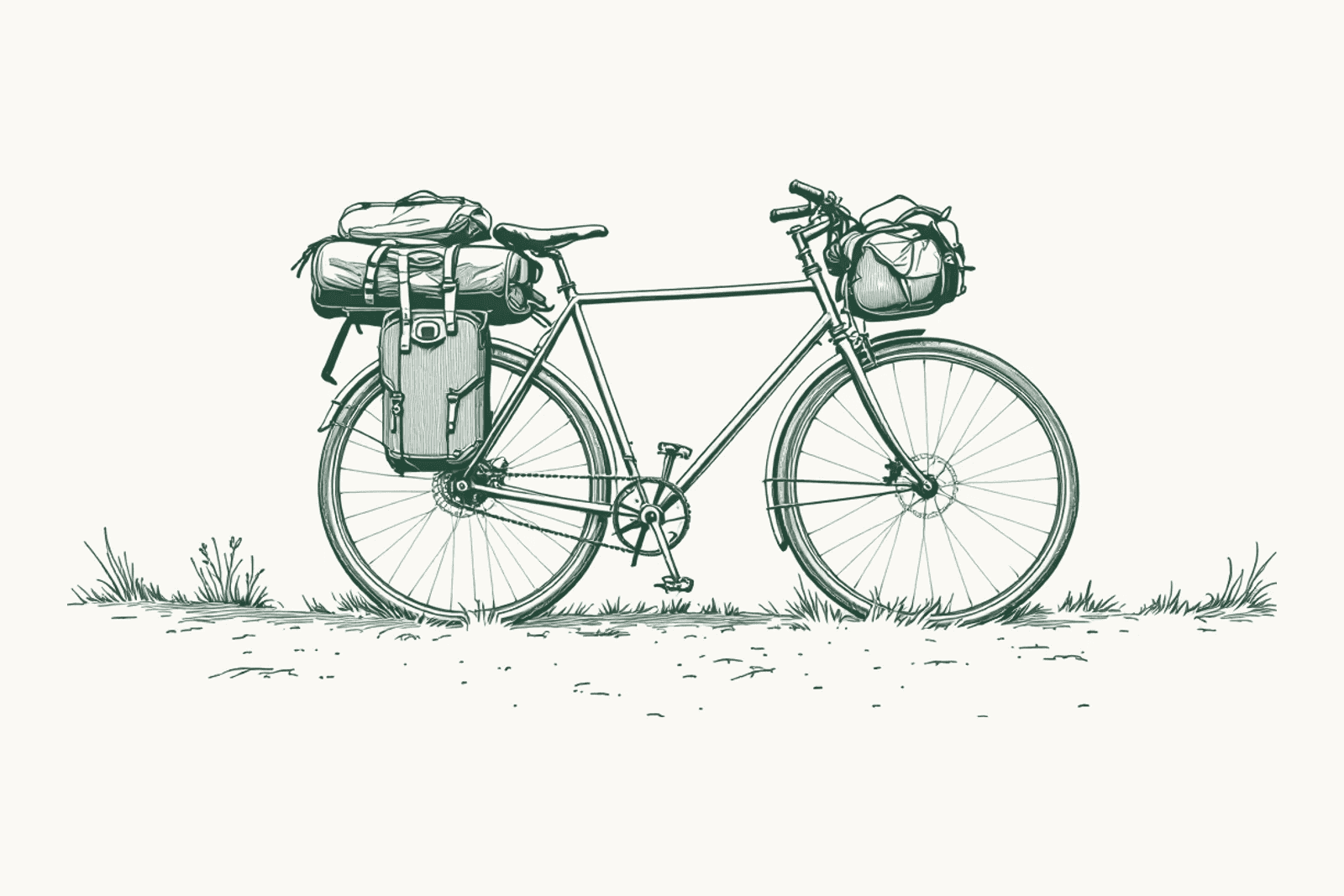
A bike tour is prepared with the same logic as a bivouac on foot, with one difference: here volume matters as much as weight, and you have to add an area that walking does not have — repairs. A forgotten bag can be replaced; a chain broken 40 km from the nearest village ends the trip.
Distributing the load
Before choosing gear you need to know where it will go. Two schools coexist.
Panniers on racks give the most volume, come off in seconds in the evening and let you reach your things without unpacking everything. This is classic cycle touring, well suited to roads and smooth tracks.
Bikepacking straps bags directly to the frame, the stem and under the saddle. Lighter, narrower, more stable on technical ground, but with limited volume and less convenient access.
Whichever you choose, one rule dominates: keep the weight low and centred. A high load on a rear rack makes the bike unstable on descents. Aim for roughly 60 % at the back and 40 % at the front, and never use a heavy backpack — the load belongs on the bike, not on your shoulders.
A handlebar bag holds what you need while riding: documents, phone, snacks, rain jacket.
The repair kit
This is the one area where you should not save weight.
- Two new inner tubes in the right size, plus a patch kit
- Two tyre levers
- A pump matched to your valves, mounted on the frame
- A multi-tool with Allen keys, a screwdriver and a chain tool
- A quick link for your chain
- Two spare spokes of the right length
- Cable ties, cloth tape and a piece of old inner tube, which between them repair almost anything
- Chain lubricant in a small bottle
- A rag
Before leaving, check tyre wear, spoke tension, the state of pads or discs, and that the rack bolts are tight. The most common failure on tour is not a puncture but a lost rack bolt: carry two spares, with locking washers.
The camp
This takes most of the bivouac gear list, with a different trade-off: a few hundred extra grams weigh less on a bike than on your back, but the available volume is tighter.
- A lightweight 1 or 2 person tent, or a tarp
- A compact hiking air mat, with its repair kit
- A sleeping bag for the season, inside a waterproof compression sack — the ratings are explained in how to choose a sleeping bag
- A canister stove, a pot, a spoon: see how to choose a camping stove
- A bottle or bidons — two bottle cages on the frame beat one large reserve in a pannier
- Head torch and power bank
The waterproof compression sack deserves emphasis: on a bike, rain does not only fall from the sky, it comes up off the wheels. Anything that must stay dry travels in a waterproof bag, even inside a pannier sold as waterproof.
Clothing
- One pair of padded shorts, two if the trip runs beyond three days
- Two breathable jerseys
- A waterproof, breathable jacket
- A light windproof, useful on descents even in fine weather
- One warm layer
- Long gloves and short gloves
- Light trousers and a long-sleeved top for the evening
- A change of shoes, or sandals, which double for the shower block
- One spare set of underwear and socks
Washing daily replaces quantity: two outfits are enough for three weeks if you wash in the evening what you wore during the day.
Safety and visibility
- Helmet
- Front and rear lights, even if you do not plan to ride at night: a tunnel or a storm arrives without warning
- Reflective gilet, required outside built-up areas at night in France
- Bell
- Lock, sized for the places you will pass through
- First aid kit, with what you need to clean and dress a gravel rash
- Sun cream: face and forearms are exposed all day
Navigation and documents
A GPS or a phone with offline maps, powered by a power bank or a dynamo hub, covers most needs. Carry a paper map of the region all the same: it never runs out of battery and gives an overview no screen replaces.
For documents: identity, health insurance card or travel insurance, third-party liability certificate, and a photo of your bike with its serial number, essential if it is stolen.
Food and water
Carry roughly one day of food, no more: resupply points are frequent across Europe, and food is the heaviest thing per litre you can carry. Do, however, always keep one emergency meal and snacks you can reach without getting off the bike.
Reckon on two bidons on the frame, plus a 2-litre soft reserve for stages without water. On remote routes, add a way to treat water.
Three common mistakes
Leaving without riding the bike loaded. A loaded bike handles nothing like an unloaded one, particularly under braking and on descents. Do a full test ride before you go.
Overestimating distances. Loaded, on an unfamiliar route, 60 to 80 km a day is already a good stage. Planning 120 turns a trip into an ordeal.
Neglecting hands and feet. They are the two contact points that decide comfort over time: suitable shoes and decent gloves are worth more than any weight saving.
Before the panniers go on, build your list around the bike and the season: it drops everything that assumes a car boot, and ticks off as you load.
Frequently asked questions
- Panniers or bikepacking bags?
- Panniers on racks give more volume, load and unload quickly, and ride more comfortably on the road. Bikepacking bags strapped to the frame are lighter, narrower and better on trails, but limit volume and access to your kit.
- How much weight should you carry on a bike tour?
- A load of 10 to 15 kg excluding water and food is comfortable for a summer trip with camping. Above 20 kg, handling and above all braking on descents change noticeably.
- What do you need to repair on the road?
- Two new inner tubes, patches, two tyre levers, a pump, a multi-tool with a chain tool, a quick link, cable ties, cloth tape and two spare spokes. That is the minimum for not depending on a rescue.
- Can you tour on an ordinary bike?
- Yes, provided it takes a rack and tyres of at least 32 mm, and its brakes are in good order. A comfortable, well-maintained bike beats a specialist one that is badly set up.