Tents
My tent is dripping: rain getting in, or condensation?
Drops are falling inside your tent at dawn. How to tell a real leak from condensation, what to do on the spot, and what to fix once you are home.
5 min read
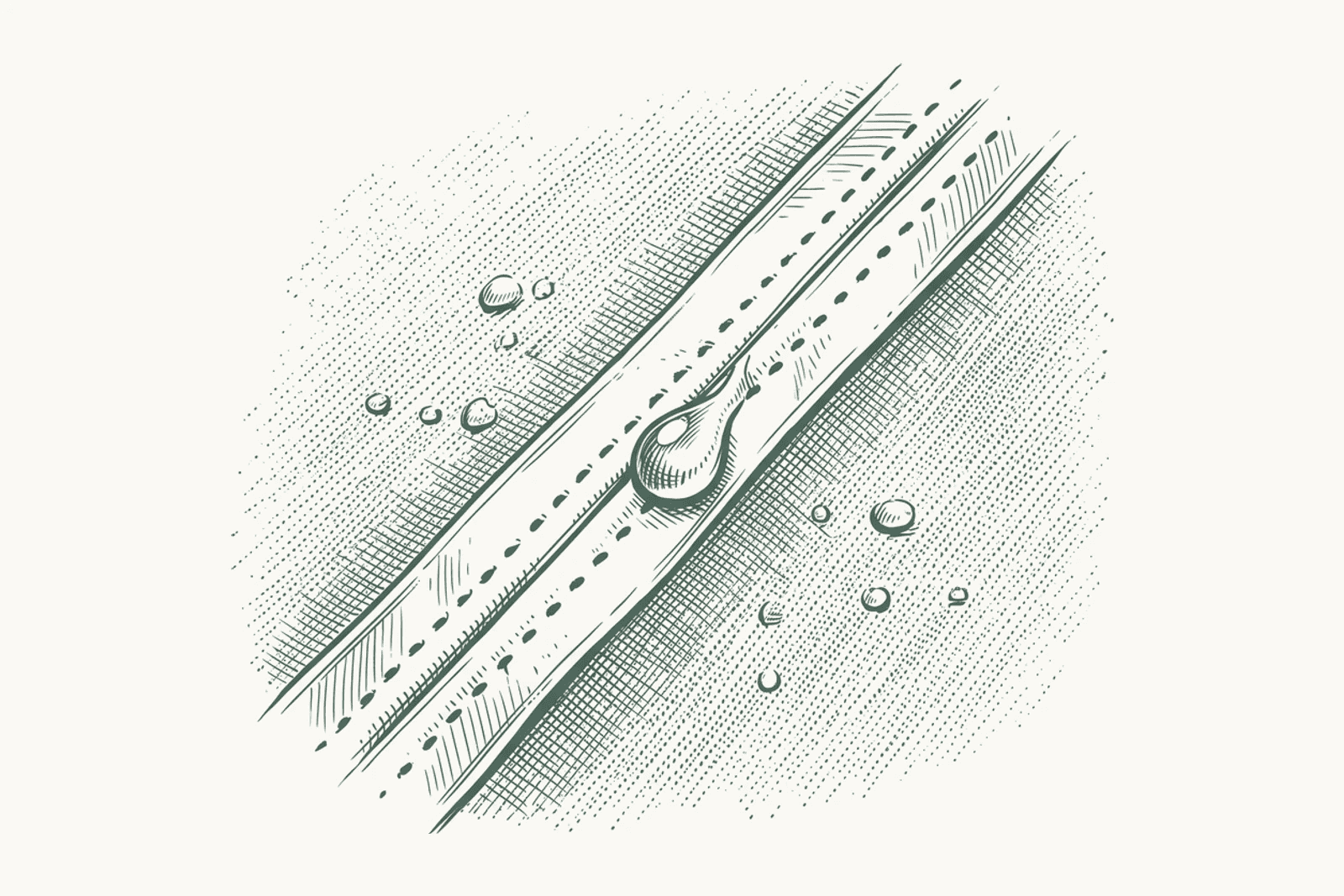
A cold drop on the forehead at 5 a.m., and the question lands with it: is that the rain, or is that me? If drops fall when it is not raining, or if the wall is wet on the inside and dry on the outside, it is condensation. If they appear during the shower, in specific places, at a seam, at a point of contact with the fabric, or if the floor starts to float, it is a leak. One is cured with air, the other with waterproofing; mixing them up costs you a night.
The three-question test
Before looking for a cause, observe, torch in hand.
- When? Condensation builds late in the night as the air cools, and carries on after rain or under a clear sky. A leak follows the rain: it starts with it and stops (more or less) with it.
- Where? A leak draws a point, a line, a localised patch: a seam, a corner, a pole sleeve. Condensation spreads: the whole ceiling beads at once, most of all above you.
- Which face? Run a finger over the outside of the fly. Wet from rain is normal. Wet on the inside while the outside is dry means vapour. And if the inner tent drips while the fly is dry beneath it, the vapour has condensed on the inner fabric itself.
One last clue: condensation is nearly pure water, with no grit and no taste. A leak often brings dust or the dye of the fabric with it.
Why condensation forms
A sleeping person gives off a few decilitres of water overnight through breath and skin; with two or three people in a small volume, the air loads up quickly. That warm, humid air meets fabric chilled by the night, the wind or the ground. Below a certain temperature, the dew point, the vapour can no longer stay airborne and condenses. At 15 °C and 80 % relative humidity the dew point is around 12 °C: fabric at 8 °C is more than cold enough.
What makes it worse:
- A low pitch, near a stream, a lake or a sodden meadow. Cold, damp air pools in hollows. A few metres higher, behind a hedge, the night is often drier.
- A tent sealed shut. The reflex against the cold, and the worst thing for vapour.
- One layer touching the other. Where the inner meets the fly, cold fabric passes its moisture on by contact.
- Wet clothes or cooking inside. They add their water to yours.
Curing condensation
The remedy is always the same: renew the air and separate the layers.
- Open the high and low vents of the fly, even on a cold night. Warm, humid air leaves at the top; drier air comes in at the bottom.
- Pitch the fly taut so a clear gap remains all round the inner. A slack fly is an air cushion thrown away. Guy lines are covered in our guide to pitching a tent in high wind.
- Aim the door so the breeze passes through without hitting you full in the face.
- Choose the site: slightly raised, out of hollows, away from water.
- Keep the wet outside: boots, clothes and washed dishes belong in the porch, not the bedroom.
The trade-off is real. Ventilating lets the cold in: on a winter night you pay a few degrees. And a single-wall tent, lighter and quicker to pitch, has one fabric doing every job; even breathable, it condenses in cold, damp air. The double wall costs weight; it buys margin. The cold-weather case is picked up in camping in winter.
Real leaks
A leak comes from a failure of the gear or a faulty pitch.
- Seams. Every stitch is a hole. Without heat-sealed tape or sealant, water gets through; over time, the tape lifts.
- The waterproof coating. Polyurethane or silicone wears, cracks and gets dirty (sun cream, resin, grease). The hydrostatic head figures quoted (see the buying guide: 2,000 mm on the fly and 3,000 mm on the floor for continuous rain) describe new fabric, not ten-year-old fabric.
- A slack fly. It sags, meets the inner, and water wicks through at the contact points. Even the best fabric wets where you touch it from inside.
- The floor. A tent pitched in a slight dip or on a slope collects water beneath it, and under pressure from your weight it comes through. A groundsheet that sticks out past the edge of the tent catches rain and channels it under the floor.
- The slope. Water runs down the ground and gets in on the uphill side.
Diagnostic table
| Symptom | Likely cause | Remedy |
|---|---|---|
| Drops across the whole ceiling, dry weather | Condensation | Open the vents, tension the fly |
| Inner fabric damp, outside dry | Condensation | Ventilate, move the tent |
| Drip at one fixed point, during rain | Seam or puncture | Seal; temporary patch |
| Damp patch where fly touches inner | Layers in contact | Retension, separate the layers |
| Water rising through the floor | Dip, slope, overhanging groundsheet | Tuck the groundsheet under, move the tent |
| Beads less each night, old tent | Worn coating | Reproof |
At 3 a.m., then at home
On the spot. Wipe the ceiling with a towel or cloth; open the vents; retension the fly; move your bag away from the walls. If it is a leak, repair tape for fabric, applied to dry cloth, will hold the night. Move to the middle of the tent so you stop touching the wall. Our emergency tips are in repairing camping gear.
Back home. Pitch the tent and let it dry completely, seams included, before packing it away: damp fabric rots and the coating degrades. Inspect the seams against the light. Reseal any that let water through, with a product compatible with the coating. Wash the fabric in clear water, then refresh the water-repellent finish if water no longer beads. Whether to choose a double wall at all is discussed in how to choose a camping tent.
One last test at home: spray the pitched tent with a gentle hose and sit underneath with a torch. Whatever drips then is not condensation.
Frequently asked questions
- Can a new tent drip without leaking?
- Yes, and it is common. Condensation has nothing to do with the age of the tent; it depends on the humid air you shut inside and the temperature of the fabric. Only a tent whose seams are not taped or sealed can leak from the first outing. Otherwise, drops in dry weather point to condensation.
- Should you leave the tent open when it is cold?
- Partly open, yes, at least at the top. A minimum of ventilation carries off the water vapour you produce while asleep. The price is a draught and a few degrees; a good sleeping bag makes up for that more easily than it does for a streaming tent.
- Can you reproof a tent yourself?
- Yes, in two steps: seal the seams that let water through with a product suited to the type of coating, then refresh the water-repellent finish on clean, dry fabric. The two jobs cure different faults, and the second never replaces the first.
- Does a single-wall tent always suffer more condensation?
- It is more exposed, since the vapour has nowhere to go between two layers. A breathable membrane or good ventilation reduces the problem without removing it. That is the cost of low weight and quick pitching.