Tents
How do you pitch a tent so it survives strong wind?
A tent that blows away has almost never failed structurally: orientation, pegs and guy lines explained so it stays put when the wind picks up.
5 min read
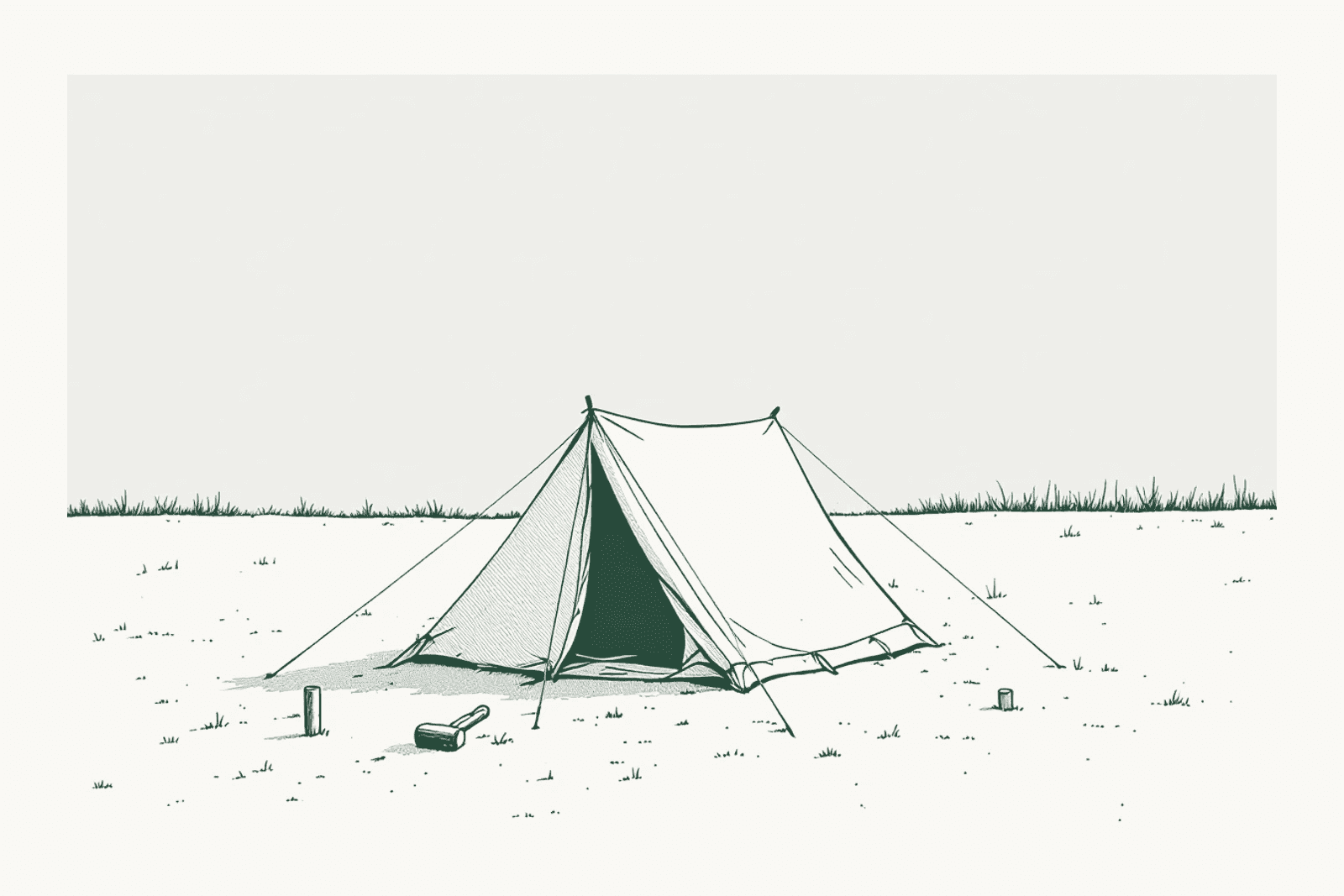
A tent that lifts off in the night has almost never failed under load: it was left empty, the door open, pitched without a single peg properly driven in. Taut fabric behaves like a sail the moment air pushes against it, and nothing holds it down if nobody thought about that when the camp went up. The fix comes down to three things, in this order: turn the lowest, narrowest end of the tent into the prevailing wind, peg every point before doing anything else, and tension the guy lines — which most campers never actually deploy.
Choosing the pitch before choosing the orientation
A natural windbreak does more for stability than any amount of fiddling with tension: a hedge, a wall, a dip in the ground all take the speed off the wind before it reaches the fabric. Look for that kind of shelter rather than settling for the first flat patch.
Three traps come up every season. The first is pitching in the lee of a lone tree: the turbulence it throws off downwind is often worse than open wind, and a dead branch that lets go gives no warning — never camp beneath one, windy or not. The second is the top of a rise, exposed on every side when a modest fold in the ground a few metres away would have done the job. The third is a dry watercourse: flat and tempting, but it channels wind like a corridor and can fill in minutes if a storm breaks upstream.
Orientation: the small end into the wind
Every tent has a broad face and a narrow one. The broad face — often the porch or the door end — acts as a sail; the narrow face, usually the back or gable end, cuts through the air instead. The rule is straightforward: narrow end and lowest point of the tent facing the prevailing wind, door on the sheltered side, away from it.
It is the same reasoning behind the geodesic frame, covered in our guide on how to choose a camping tent: multiplying the pole crossings cuts down the surface that can catch wind from any direction, which a family tent with large flat panels is not built to do.
Pegs are the whole subject
A tent does not stand because it is heavy or well designed; it stands because every anchor point resists being pulled out. Ground type dictates peg type:
| Ground | Right peg | Why |
|---|---|---|
| Soft earth, turf | Standard round pin | Easy to drive in, but pulls loose alone once wind picks up |
| Firm ground, campsite pitches | V- or Y-section peg | The profile resists bending under sideways load |
| Sand, packed snow | Wide plastic or T-shaped peg | Holding power comes from bearing surface, not depth |
| Bare rock, ground you cannot penetrate | Weighted rock or a buried deadman anchor | You load a fixed point instead of driving anything in |
Angle matters as much as the peg itself. A peg driven straight down gets levered out by the pull of the line, which always tugs at an angle; driven at roughly 45°, tilted away from the direction of pull, it works along the axis of the load instead of acting as a lever against itself. Depth follows the same logic as a climbing anchor: a peg half in the ground will hold a sun shade, not a tent under gusts. A mallet and a few spare pegs earn their place on any camping gear checklist, because they, not the fabric, are usually what gives way first.
Guy lines, invisible but decisive
A guy line is not there for show: it transfers load from the top of the poles down to the ground, away from the fabric itself, and it stops the material from drumming — that repeated flapping, which keeps you awake at night, is also what wears out the stitching. Without guys, all the wind resistance falls on the poles alone.
Tension them firmly, not tight as a drum: an over-tensioned line passes shocks straight to the poles instead of absorbing them. Check them again after rain. Most cords slacken as they dry, leaving enough play for the fabric to start flapping again the moment the next gust arrives. On exposed ground — pitched on a ridge for a night out, say — a bivouac gear list will often include extra guy lines and reinforced pegs for exactly this reason.
Poles: flex rather than break
An aluminium pole flexes under a gust and springs back once the load eases; that is the whole point of the metal on this score. Fibreglass, stiffer by nature, copes less well with repeated flexing and eventually splits into splinters, often right at a sleeve joint. If a sleeve tears in the middle of a windy night, a stopgap repair — a short length of rigid tube slid over the break and secured with strong tape — will see you through until morning; it is not a substitute for a new pole once you are home.
The rule everyone forgets
A tent left standing and empty during the day, door open, pegs barely in the ground, is a balloon waiting to happen: air enters through the opening, builds up inside, and the fabric has nowhere to go but up. That is the most common way tents actually take off — mid-afternoon, while everyone is at the beach or out walking, not while anyone is inside taking the load. The fix costs nothing: shut the door before you leave camp, and check that every peg is properly seated.
Ordinary maintenance in windy weather
After a squall, walk the camp: a peg that has shifted by a few centimetres is enough to slacken an entire panel of fabric. The same check is worth doing after a stretch of winter camping in extreme cold, when strong wind is more frequent and frozen ground makes driving pegs harder in the first place.
One limit no amount of tensioning will move: nothing built around the usual family camping gear is a mountain tent. Once wind clearly exceeds what it normally handles, the right call is not a better pegging job — it is to take the tent down.
Frequently asked questions
- Which peg works best on sandy ground?
- A wide plastic or T-shaped peg that holds by its bearing surface rather than by how deep it goes in. A standard round pin pulls straight out of sand at the first gust, whatever length you buy.
- Should guy lines be re-tensioned after rain?
- Almost always, yes. Many cords slacken as they dry out after getting wet, or stretch when soaked. A quick check the morning after a shower stops a slack line from being useless once the wind returns.
- Can you leave a tent pitched and empty if wind is forecast?
- Only closed up and fully pegged down. Left with the door open or the fabric slack, an empty tent behaves like a balloon: air gets in, has nowhere to go, and the whole structure lifts. With nobody inside to weigh it down, it is safer to drop it.
- Can a family tent survive a storm?
- No, and that is not what it is built for. Tents designed for family holidays are optimised for living space, not structural resistance. Once wind clearly exceeds what the tent normally copes with, the sensible response is to take it down, not to peg it harder.