Tents
Pop-Up Tents: Who Are They Actually For?
A pop-up tent pitches in seconds but folds awkwardly, packs bulky and struggles in wind: here's exactly who it suits and who should choose differently.
6 min read
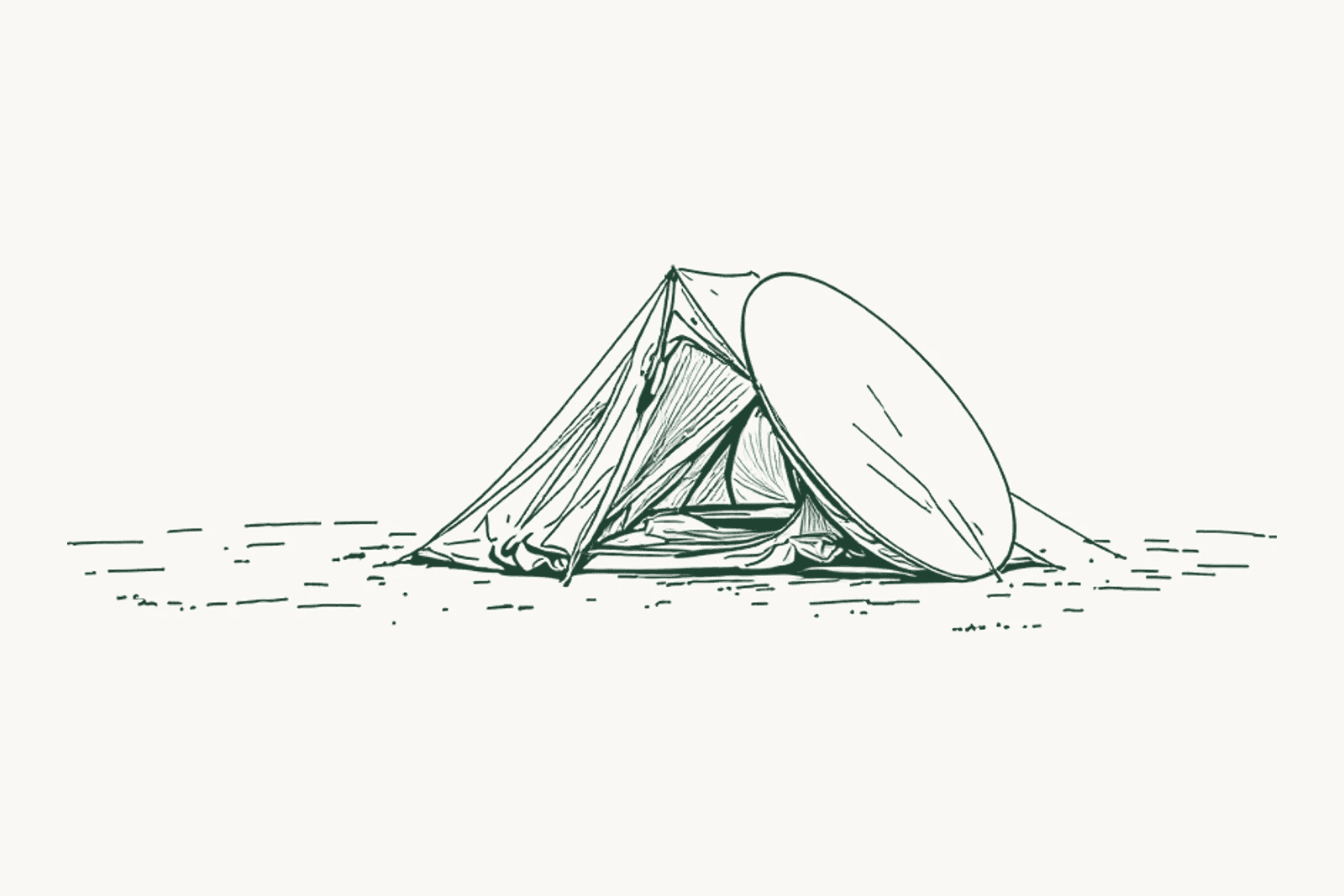
Pull it from its bag, release the clips, and it springs into shape on its own: under a minute later, a pop-up tent is pitched. A pre-tensioned hoop built into the fabric does the work, not you. That speed makes it the right tool for a late arrival at a campsite, a one-night stop on a road trip, a festival, an afternoon at the beach, or a child’s first tent. It stops being the right tool the moment a trip runs past two or three nights, the weather turns, or the tent has to go on your back: this isn’t a lesser tent, it’s a tent that has traded wind resistance, weight and packed size for pitching speed.
The mechanism: a spring, not an assembly
Unlike a conventional pole tent, where you thread poles through sleeves, a pop-up tent has pre-tensioned hoops sewn directly into the fabric — the same principle as a spring-loaded fabric hoop in a collapsible laundry basket or a photographer’s reflector disc. Folded, the tension is locked into the fold; released, it snaps back into its finished shape by itself. Nothing to assemble and nothing to lose along the way — no spare peg forgotten, no pole section left behind in the grass.
The trade-off shows up the day a hoop breaks. On a conventional tent, a split fibreglass or aluminium pole section is fixed on the spot with a spare ferrule, in a couple of minutes. On a pop-up tent, the hoop is sewn into a closed sleeve that cannot be taken apart: a break usually ends that panel, if not the whole tent. It’s a mechanism built never to fail in normal use, not to be repaired when it does.
What it genuinely wins
The benefit isn’t in question: a pop-up tent pitches without instructions, without a learning curve, in under a minute, by one person working alone. That earns its keep in specific situations:
- arriving after dark, when pitching by head-torch is nobody’s idea of fun;
- a one-night stop along a road trip, where pitching time matters more than comfort;
- a festival, where the tent stays up for two or three days on a packed field;
- a beach or garden shelter, put up and taken down several times in a day;
- a child’s first tent, one they can pitch themselves and feel is theirs.
In each of these, pitching speed matters more than storm resistance or packed size. For a more conventional camping trip, the criteria change completely — see how to choose a camping tent for the capacity, season rating and hydrostatic head figures that apply there instead.
What it costs
That pitching speed is paid for in three places.
First, packed size: a pop-up tent folds into a wide flat disc, often 70 to 90 cm across, that fits no rucksack and barely fits a small car boot. Second, weight against usable space: the built-in hoop weighs more than a conventional pole set for a comparable interior. Third, and by far the most common complaint, is folding it back up.
Packing a pop-up tent away is genuinely counter-intuitive: you need to find the right twist point and fold against the direction that feels natural, and the move doesn’t reveal itself from watching it done once. It’s a learned movement, like folding a road map or a photographer’s reflector — not a flaw in the tent. The best time to learn it is a sunny afternoon in the garden before the trip, not a car park in the rain with the family waiting in the car.
Wind and rain show no more mercy here
The spring that tensions the fabric doesn’t grip the way poles paired with adjustable guy lines do: it locks in one shape rather than being tensioned progressively the way you’d tighten a guy line by hand. As a result, a pop-up tent handles gusts less well than a conventional pole tent of similar size.
The trap is that standing up unaided tempts people to skip pegging it out altogether — why stake down a tent that already stands on its own? That’s exactly why it’s the tent most often seen tumbling loose across a campsite field on a windy day: nobody weighted it down. Peg and guy it out like any other tent, even for one night: the four corners first, side guy lines if the wind picks up.
Ventilation and condensation
Many pop-up tents are single-skin, or have a partial flysheet that only covers the roof. That matters: a sleeping person gives off close to half a litre of water overnight as vapour, which condenses on contact with an outer wall colder than the air inside — the same thing that fogs a car window, happening on fabric instead of glass. On a single skin, that water drips straight onto the sleeping bag.
A full double skin, with an air gap between a breathable inner and a waterproof flysheet, moves the condensation onto a surface you never touch while sleeping. That’s what most entry-level pop-up tents lack, and why they suit one fine night but turn uncomfortable the moment it rains or the nights turn cool.
Who should look elsewhere
Three types of trip call for something else: a week camping in one spot, where packed size stops mattering and daily comfort takes over; autumn or mountain conditions, where sustained wind and rain outrun what a spring hoop can manage; and anyone carrying the tent on their back while hiking, where weight and bulk rule a pop-up out against a proper trekking tent — see the bivouac gear list for what actually matters there.
For a family weekend where several tents share a pitch, the tent is rarely the only question anyway: see family camping gear and, more broadly, the camping gear checklist so nothing gets left behind when the car is loaded. And for a first camping trip with no prior experience to draw on, it’s worth reading what gear you need for camping before letting pitching speed alone decide the tent.
At a glance
| Situation | Pop-up tent | Conventional tent |
|---|---|---|
| Late arrival, one night | Good choice | Overkill for the job |
| Festival, 2–3 days | Good choice | Awkward to carry in |
| A week in one spot | Not recommended | Better suited |
| Autumn, mountains, strong wind | Not recommended | Necessary |
| Hiking, carried on your back | Too heavy and bulky | Dedicated trekking tent |
Buying a pop-up tent second-hand, the only check worth doing is on the hoops, not the fabric: look for a hairline crack or a weak point where a hoop is sewn in, the sign of material fatigue that predicts a break rather than one you’d only discover afterwards. That check takes less time than pitching the tent itself.
Frequently asked questions
- Do pop-up tents cope with wind?
- Less well than a conventional pole tent of the same size: the built-in spring locks in a shape rather than tensioning progressively the way a guy line does. Peg and guy it out every time, even for one night — it's precisely the tent most often found blown over for lack of being staked down.
- Why is folding a pop-up tent so hard?
- The move involves twisting the fabric against a direction that feels wrong, to cancel out the spring's tension, and it doesn't reveal itself from a diagram. It's a learned movement, like folding a road map: better to practise once in the garden before the trip than to work it out in the rain on the day you leave.
- Is a pop-up tent fine for more than one night?
- For two or three nights in fair weather, yes. Beyond that, the frequent lack of a full flysheet becomes a condensation problem, and daily comfort suffers from interior space that's small relative to its weight and packed size.
- Can a broken pop-up tent be repaired?
- Rarely in the field. The pre-tensioned hoop is sewn into a closed sleeve, whereas a broken conventional pole is fixed in minutes with a spare ferrule. A break usually ends that tent's useful life, which is worth knowing before you buy.