Cooking
How to organise a camp kitchen
Organising a camp kitchen: where to set it up, the kitchen crate, managing water and the cool box, washing up, food safety and simple menus.
4 min read
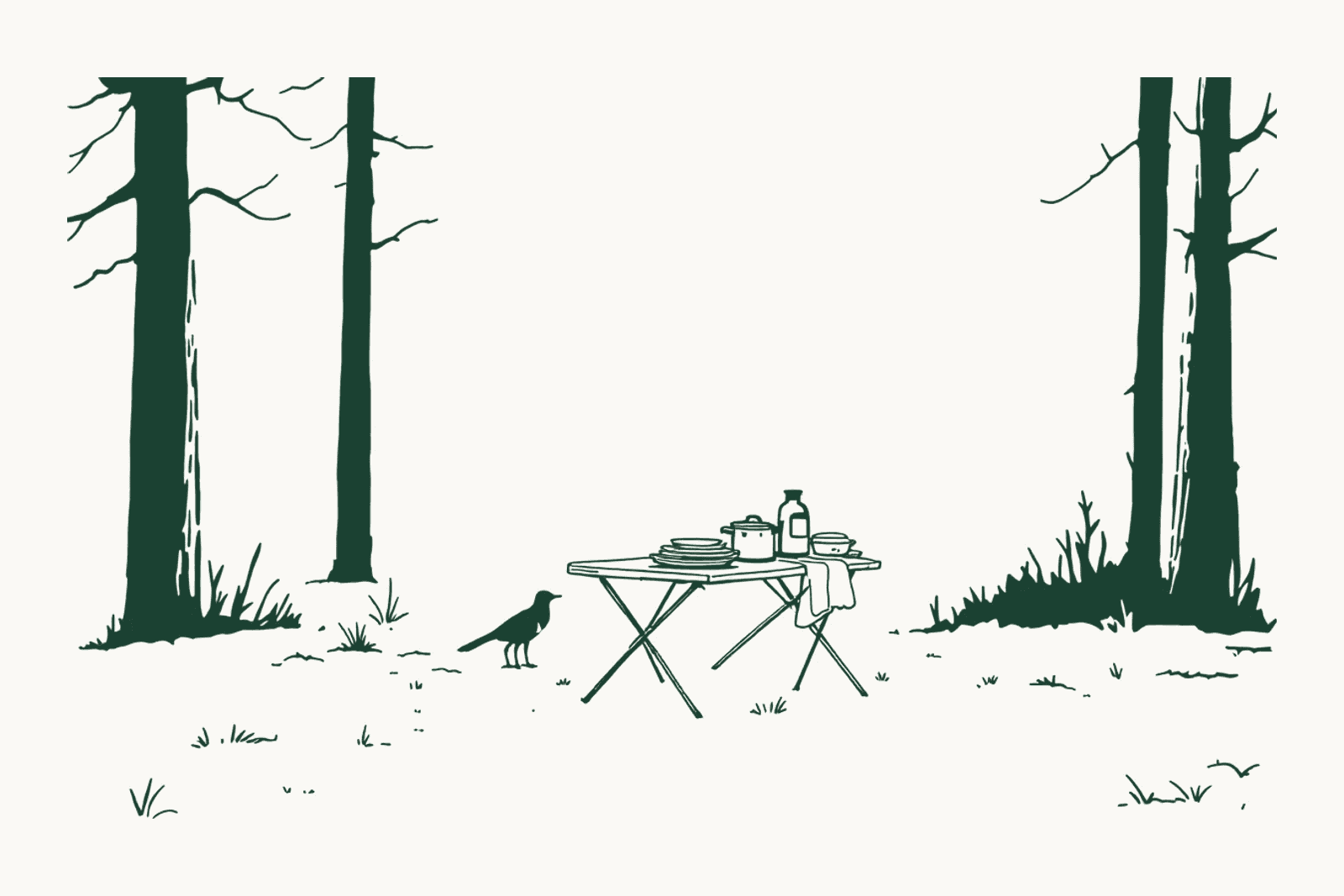
A camp kitchen works when everything has a place and the cooking point stops moving. Comfort does not come from the amount of equipment but from its arrangement: a kitchen crate, a stable work surface and a clear system for water and the cool box are enough to cook real meals, four-handed and in the rain.
Setting up the cooking area
The first thing to do on arrival is decide where you cook — before unpacking anything.
- Away from the tent, for smells, fire safety and insects.
- Under an awning or tarp, open on at least two sides. Never in an enclosed space: a stove produces carbon monoxide.
- Back to the prevailing wind, which improves both stove efficiency and comfort.
- Near the water point, if you get to choose your pitch.
Once the station is set up, do not move it. Half the mess in a camp comes from a kitchen that migrates over the days.
The kitchen crate
This is the central tool. A rigid closed crate, carried as it is and set down by the work surface, holding everything that does not mind heat. It saves you opening six different bags to make a coffee.
Typical contents:
- stove, canister in use, spare canister, igniter and matches;
- nesting pots, frying pan, lids;
- plates, bowls, mugs, cutlery;
- kitchen knife in a sheath, thin chopping board, tin opener, peeler;
- salt, pepper, oil in a small bottle, spices in pill jars;
- sponge, washing-up liquid, tea towel, kitchen roll;
- bin bags and freezer bags;
- a light dedicated to the kitchen.
The chopping board deserves a mention: on the table it is a clean work surface, and on your knees it is a backup one when the table is occupied.
Managing water
Allow 3 litres per person per day for drinking and cooking, and 2 more if the tap is far. Two containers beat one large one: a reserve jerrican on the ground, and a 5-litre tap bottle raised up, which lets you wash hands and rinse without handling the reserve.
Away from managed sites, water from a spring or river must be treated — filter, tablets or a minute at a rolling boil — before drinking.
The cool box, in practice
Five habits determine most of its performance:
- Pre-chill the box and its contents the day before you leave. A warm box spends its cold reserve just getting down to temperature.
- Fill it completely. Empty space is the enemy: fill gaps with frozen water bottles, which become cold drinks as they melt.
- Put the ice packs on top. Cold falls.
- Open it as rarely as possible. Take everything you need in one go.
- Keep it in the shade, under a damp cloth if you like, never in a sunny boot.
A well-prepared rigid box holds for two to three days. A thermoelectric cool box drops about 15 to 18 °C below ambient — not enough in a heatwave — while a compressor box works like a real fridge, at a higher price and power draw.
Organise the inside in layers: the most perishable items — meat, fish, dairy — at the bottom against the cold, drinks and fruit on top.
Food safety
The rules are simple and non-negotiable above 20 °C ambient:
- raw meat and fish eaten on the first day, or avoided in favour of tins;
- separate board and knife for raw and cooked, or washing in between;
- eggs kept out of the heat, never in an exposed boot;
- leftovers cooled quickly, stored airtight in the coldest part of the box, and eaten within 24 hours;
- hands washed with soap and water before every preparation.
Washing up
A folding bowl, a little hot water and biodegradable soap are enough. The method that saves most time is to wipe the residue off with paper before washing: it cuts the water needed and saves you straining greasy water afterwards.
On a managed campsite, use the sinks provided. In open country, move at least 60 metres from any watercourse, strain out the food scraps and carry them away with your rubbish. “Biodegradable” soap breaks down in soil, not in a river.
Simplifying menus
Three principles cut the workload sharply:
One-pot meals. One pan to wash instead of three.
One cold meal planned in advance. For the evening you arrive, when the tent is not up, and for the rainy day when nobody feels like cooking.
With children the rhythm of meals changes the answer: see family camping gear.
Breakfast prepared the night before. Oats, milk powder and dried fruit in a closed bowl: only the hot water is left to do.
Finally, decant dry goods into reusable containers before leaving. Original packaging takes up a lot of space, tears, and ends up as rubbish to carry home.
For the stove itself, see how to choose a camping stove; for the full kit, the complete checklist.
Frequently asked questions
- How do you keep a cool box cold for longer?
- Pre-chill the box and its contents the day before, fill it as full as possible — empty space is the enemy — put the ice packs on top since cold falls, open it as rarely as you can, and keep it in the shade under a damp cloth rather than in direct sun.
- How much water per person per day?
- Reckon on 3 litres per person per day for drinking and cooking, and 2 more for washing up and a basic wash if the tap is far away. A 10-litre container therefore covers roughly a day for two people.
- Where should you wash up when camping?
- At the sinks provided on a managed campsite. In open country, at least 60 metres from any watercourse, with biodegradable soap, straining out food scraps to carry away with your rubbish. Biodegradable soap is still a pollutant if it goes straight into water.