Furniture
How to choose a camping table and chairs
Suitcase or roll-top tables, low chairs, steel or aluminium folding frames: seat height, stability on soft ground and weight, compared properly.
5 min read
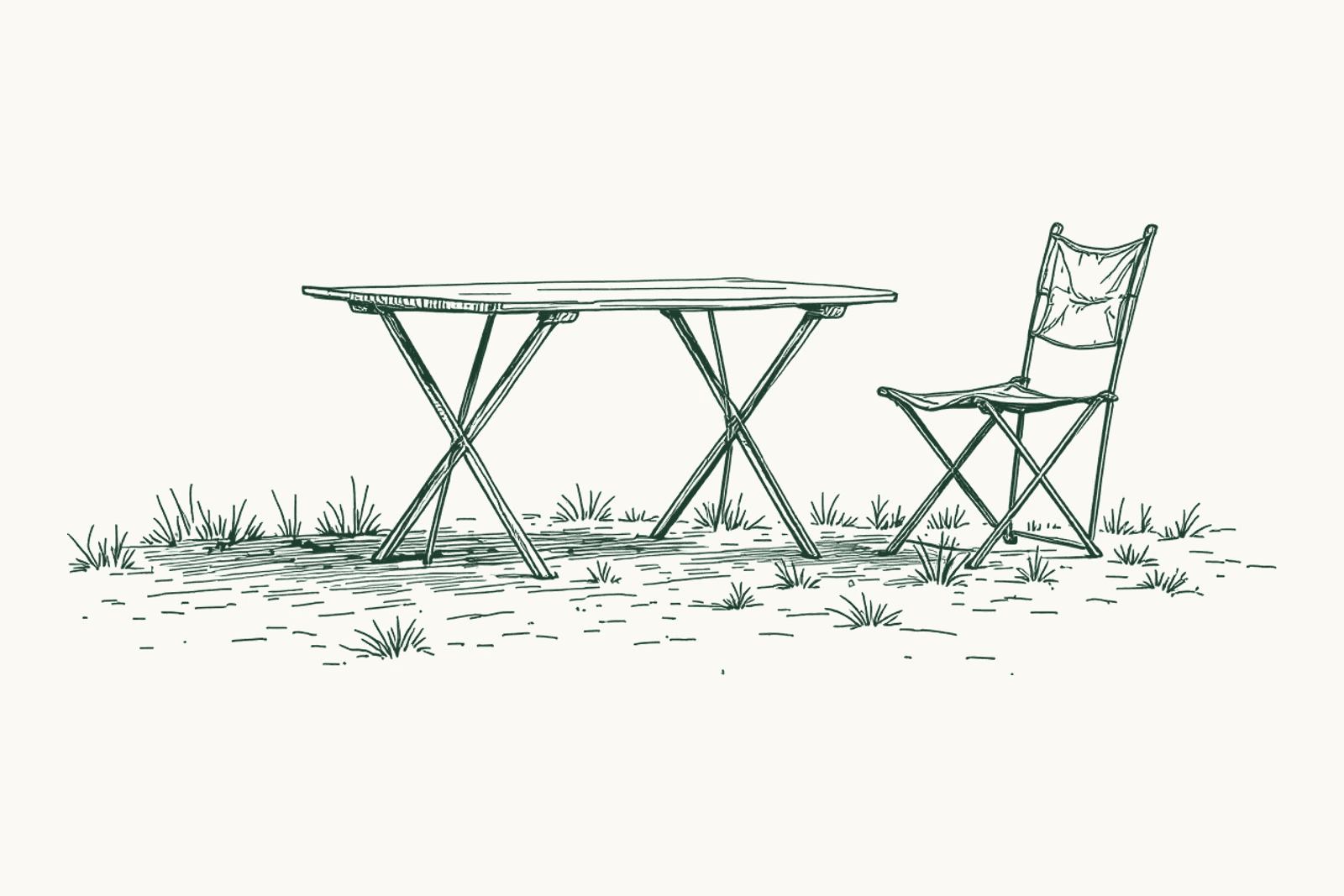
Balancing a plate on your knees is fine on the first night. By the sixth, with vinaigrette sliding off the rim and a back that has started to complain, it’s rather less fine. For a multi-night stay at the same pitch, the question isn’t whether you need a table and chairs, but which ones: a stable table with adjustable legs and wide feet, and chairs with a seat height of 40 to 45 cm — the height of an ordinary dining chair — so you can eat without folding yourself in half. Below two nights, or the moment gear has to go on your back, this furniture turns into dead weight.
Tables: two ways of folding
The suitcase table folds its top in half lengthways, exactly as the name suggests. Rigid once open, it sets up in seconds, and its flat surface takes a knife pressing down without flexing. Its drawback is that same rigidity: folded, it keeps the length and width of a briefcase and claims whatever boot space you give it.
The roll-top table builds its surface from wooden or aluminium slats linked together, which roll up around the folded legs once the table comes apart. The resulting bundle slides into a narrow bag and weighs noticeably less than a suitcase table of comparable size. In exchange, the slatted surface flexes slightly under a point of pressure — cutting on it takes a bit more care, and crumbs collect in the gaps.
Between the two, the choice comes down to actual use: cooking and eating repeatedly at the same pitch favours the suitcase table for comfort; gear that travels often favours the roll-top for weight and bulk. Either way, check that the legs adjust for height — sloping ground quickly makes a fixed-height table unusable — and that the feet are broad rather than pointed.
Chairs: three families, three uses
Low beach-style chairs, fabric stretched over a light frame, put the seat at 25 to 30 cm off the ground, close to a floor cushion. Excellent for relaxing round the fire or reading a book, they leave your knees above the level of a standard camping table: eating in one means leaning forward the whole time.
Steel-frame folding chairs, the familiar supermarket format, put the seat at table height, carry a good load and hold up well over years of use. Their drawback is weight: steel, roughly three times denser than aluminium for equal strength, adds up fast once you’re carrying more than one.
Aluminium folding or dismountable chairs keep the same seat height with a thinner tube frame, sometimes splitting into several pieces that pack into a narrow bag. They roughly halve the weight of a comparable steel model, at the cost of a generally lower load rating and somewhat shorter life in the joints.
| Format | Seat height | Typical weight | Packed size |
|---|---|---|---|
| Low beach-style chair | 25–30 cm | 2 to 3 kg | Wide, cylindrical bag |
| Steel-frame folding chair | 40–45 cm | 4 to 6 kg | Bulky, chair-shaped |
| Aluminium dismountable chair | 40–45 cm | 1.5 to 2.5 kg | Narrow bag, bottle-sized |
Judging stability on soft ground
The number of legs matters less than their footprint. A thin leg tip, even on four points of contact, concentrates the whole weight onto a few square centimetres and sinks into dry sand, grass soaked after rain, or loose soil — the table or chair then tips the moment someone leans to one side. Wide feet, or legs that flare into a diamond shape to spread the load over a larger area, solve most of these situations without any extra kit.
On genuinely unstable ground — fine sand, peat — a simple trick is to set each foot on a flat stone or an offcut of wood found nearby, which acts as an improvised snowshoe. Steer clear of three-legged tables and chairs on uneven terrain, though: stable in theory on flat ground, they lose that advantage the moment the surface isn’t perfectly level.
Weight and bulk: what actually matters
For a couple with one table and two chairs, the gap between an all-steel set and an all-aluminium one can run to several kilograms and a third less bulk once packed away — a minor factor when everything travels by car, but a decisive one the moment gear has to be carried a few hundred metres from car park to pitch, or strapped to a bike. It’s also the weight you handle at every setup and pack-down: a light set unfolds and stows without effort, while a heavy one gets dragged.
Is the furniture worth it?
It depends on how long you’re staying and how you’re travelling. For a family camping weekend with the car parked next to the tent, a decent table and chairs genuinely change the comfort of the trip and earn their place in the boot — see the complete camping gear checklist so nothing around mealtimes gets forgotten.
For one or two nights, or the moment gear has to be carried, the logic reverses. A groundsheet or tarp is enough to sit on, and an ultralight folding stool, often under 500 g, replaces a full chair without weighing on your back — the same logic applies on a bivouac, where every non-essential item is one item too many. In between, the simplest test is transport: if the table or chair travels to the pitch without you carrying it yourself, it earns its place; if not, it ends up as dead weight at the bottom of the boot, never unfolded.
Once the table is chosen, it also shapes how the camp kitchen comes together: with no dedicated worktop, the stove usually ends up on it.
Frequently asked questions
- What seat height do you need to eat comfortably at a table?
- Around 40 to 45 cm, the same as an ordinary dining chair, under a table 68 to 72 cm high. A low beach-style chair, with a seat at 25-30 cm, puts your knees above the table: fine for lounging, awkward for meals.
- How do you know if a table or chair will stand up on soft ground?
- Look at the footprint of the feet, not just how many there are. Thin tips sink into sand or wet grass and tip the whole thing over; wide feet, or legs that flare into a diamond shape to spread the load, stay stable on most campsite ground.
- Should you take a table and chairs hiking or on a bivouac?
- No. This furniture only makes sense for a car-camping stay at a fixed pitch. The moment you have to carry your own gear, a groundsheet or an ultralight stool under 500 g does the job, and a folding table becomes dead weight.