Furniture
Camping Lanterns and Head Torches: How to Choose
Battery, USB, dynamo or gas lanterns; head torches with red-light mode: what the numbers actually mean before you buy camp lighting.
5 min read
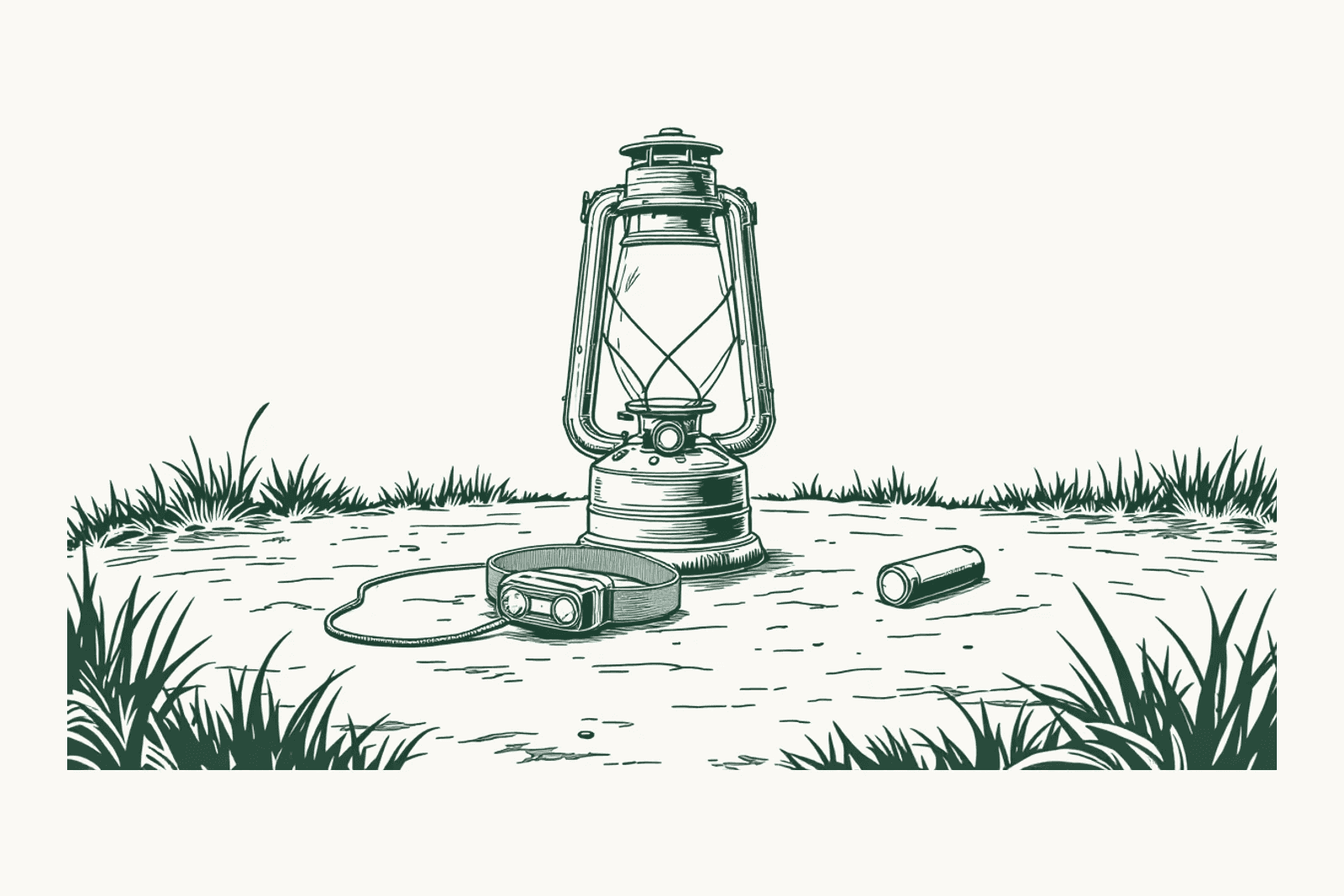
A camp that relies on a single light always ends up half-served: too diffuse to spot a tree root on the way to the loos, too narrow to light the cooking pot while everyone eats. The answer is straightforward: you need two lights, not one — a lantern that lights a space diffusely, set on the table or hung from the awning, and a head torch that lights exactly where you look, hands free, for pitching, cooking or walking in the dark. One good lantern and one good head torch beat a pile of mediocre lights.
Lanterns: four power sources, four trade-offs
The battery or rechargeable LED lantern has become the default choice: instant on, no flame, and several evenings of light from one charge or one set of batteries. Its only real drawback is that it depends on a reserve of energy you need to remember to top up before you leave.
The USB-rechargeable lantern works the same way but charges from a power bank, a car socket or a solar panel, which suits longer trips away from mains power.
The crank-dynamo lantern never runs out for good: a few minutes of winding buys a few tens of minutes of light, with no battery to replace or charge to plan. The cost of that independence is the runtime itself — it is measured in effort, not hours, and a flat lantern is fixed by winding, not by resting.
The gas lantern gives a warm, wide throw of light that few LED lanterns match, good for lighting a whole dinner table or cooking corner. In exchange it produces a naked flame and real heat at the mantle: it belongs outside, never under canvas, even with the door open.
| Type | Power source | Strength | Limit |
|---|---|---|---|
| LED, battery/rechargeable | Batteries or built-in cell | Simple, instant on | Reserve needs charging or replacing |
| USB-rechargeable LED | Power bank, mains, solar | Copes with long trips | Depends on a charging source |
| Crank dynamo | Manual effort | Never runs out for good | Runtime limited to effort put in |
| Gas | Gas cartridge | Warm, powerful light | Naked flame, heat, never under canvas |
An LED lantern set on a stable camping table covers most evenings; keep a gas version, if you carry one, strictly for outdoor use.
Head torches: the light that leaves your hands free
A hand-held torch lights a fixed point and ties up one hand the whole time — awkward the moment you need to hammer in a peg, work a zip or steady a pan. A head torch solves this by following your gaze: it lights whatever you’re looking at, without occupying anything but your head.
Most models offer a red-light mode, dimmer and without the wavelengths that disturb night vision the most. It does two jobs at once: it preserves your eyes’ adjustment to the dark, useful for finding your way without full brightness, and it stops you sending a white glare into the tent next door at eleven at night. On a shared campsite or bivouac spot, sweeping a white beam at eye height across neighbouring tents remains one of the small acts campers resent most; a simple habit — pointing the beam down as you walk rather than letting it rise towards other pitches — avoids most of the trouble.
Lumens, beam and runtime: reading the numbers correctly
A lumen measures a quantity of light emitted, not its usefulness for a given task. A narrow, powerful beam rated at 1,000 lumens throws all that light onto a single distant point: excellent for spotting a path far ahead, useless for lighting a table where people are eating, where a wide 150-lumen flood setting will do a far better job by covering the whole scene without dark edges or a blinding centre. Before comparing two torches on peak output, it is worth checking whether each offers a wide (flood) setting and a focused (spot) setting, and which one actually matches the task at hand.
The stated runtime almost always refers to the lowest, least power-hungry setting — an honest figure, but one that says nothing about the time you’ll actually get at the brightness you’d normally use after dark, which is usually far shorter. A torch rated for 100 hours will rarely last more than a fraction of that once set to a level that’s genuinely usable at night.
Batteries and cold: the sleeping bag as shelter
Lithium batteries, whether built-in cells or rechargeable batteries, lose a real share of their usable capacity as the temperature drops — a chemical effect, not a fault, and generally reversible once the battery warms up again. A torch rated for a full night can go flat in a couple of hours at -5 °C. The simplest fix is to slip the torch, switched off, into your sleeping bag against your body: body heat is enough to keep the battery in a range where it delivers its normal output. For everything else that cold weather changes about your gear, see the full guide to winter camping and extreme cold.
Safety: never a flame under canvas
A gas or liquid-fuel lantern must never run inside a tent, even with the door open, even for a few minutes. Two risks stack up together: carbon monoxide, an odourless gas produced by any combustion in a poorly ventilated space, and contact between a flame or a hot surface and synthetic fabric, which catches and melts within seconds. Neither risk forgives a lapse in judgement; the only naked flame that belongs under canvas is the one that isn’t there.
Building your lighting kit
For a standard camping trip, one main LED lantern, one head torch per person and a smaller lantern for the cooking corner cover most needs — you’ll find this base covered in the full camping gear checklist. On a bivouac, where every gram counts, the head torch is often the only light carried, with a lantern reserved for fixed camps where you cook and settle in for several nights, particularly around the camp kitchen, where steady, diffuse light matters more than raw output.
Frequently asked questions
- Is a gas lantern better than an LED lantern?
- It throws light wider and gives a warm tone many people prefer, but it produces a naked flame and real heat: it must never go inside a tent or a closed awning. A comparable LED lantern rarely matches that warmth of light, but it works anywhere, including indoors, without any risk of fire or carbon monoxide.
- How many lumens does a camping head torch need?
- The figure alone says little about real use: around a hundred lumens on a wide, flood setting is plenty for cooking, reading a map or walking a known path, whereas a narrow 300-lumen beam only lights a single point far ahead. Look instead for whether the torch offers both a wide setting and a focused one, which matters more than the headline maximum output.
- Why does my rechargeable torch run down faster in winter?
- Lithium batteries lose part of their usable capacity as the temperature drops, an effect that is real but reversible once the battery warms back up. Slipping the torch inside your sleeping bag overnight, against your body, is usually enough to limit the loss.
- Can you leave a lantern on overnight inside the tent?
- An LED lantern on a low or standby setting, yes, without particular risk. A gas or liquid-fuel lantern, never: even turned down low, it consumes oxygen and releases carbon monoxide in an enclosed space, a danger that is neither seen nor smelled until it is too late.