Sleeping
Sleeping arrangements for children when camping
Why children get cold faster, which sleeping bag and mat to buy in their size, where to put them in the tent, and how they get back to sleep at night.
7 min read
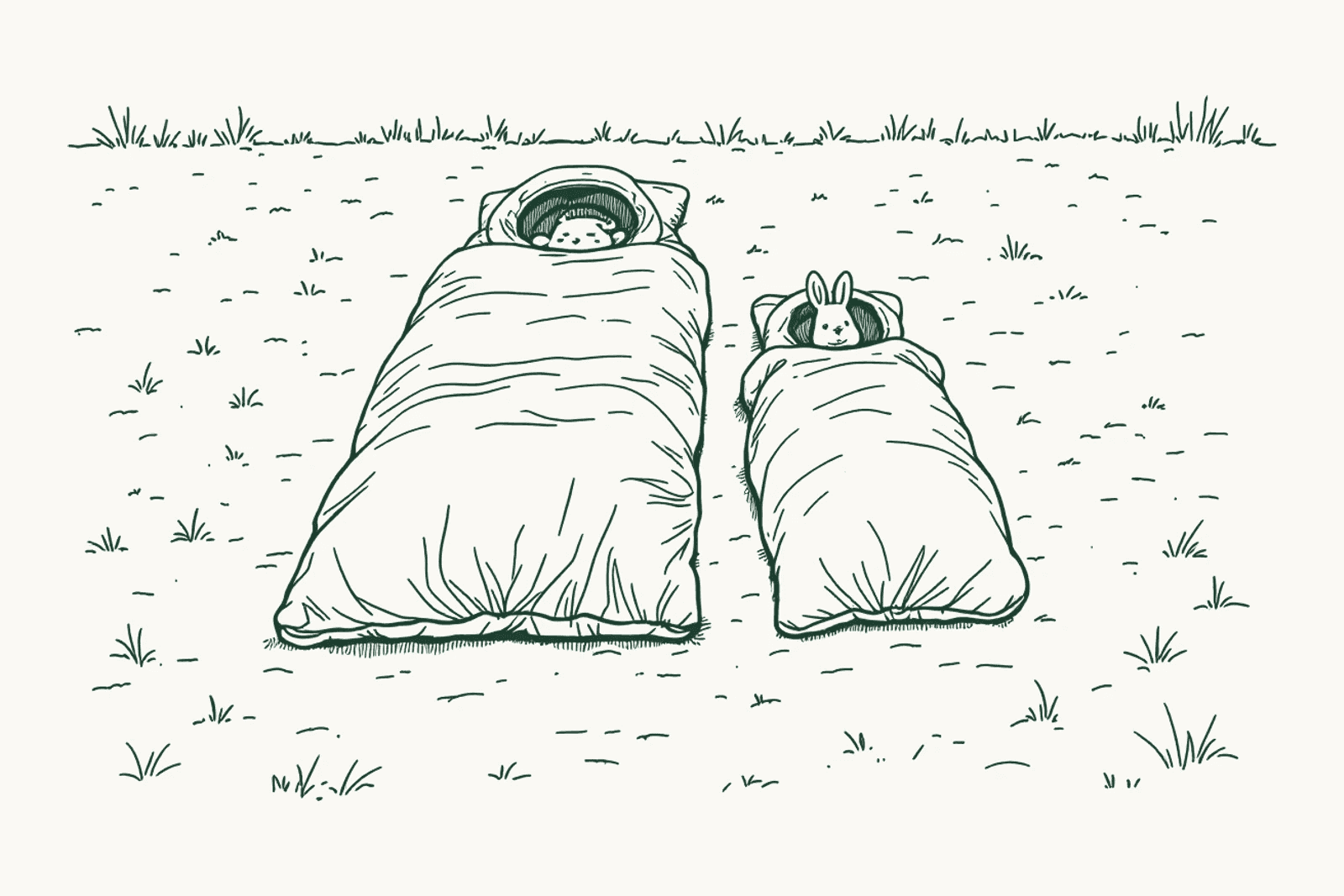
Two things decide a child’s night under canvas, and neither of them is the warmest sleeping bag on the shelf. The first is insulation from the ground: a child loses heat to the earth faster than an adult, because their skin area is large relative to their mass. The second is the size of the bag: in an adult bag they have to warm a volume of air they do not fill, and they do it badly. A good mat and a junior bag beat an expensive bag on a thin foam pad. Everything else — the dark, the noise, the hour they wake — is preparation, and it happens before you leave.
Why children get cold faster
The ratio of body surface to body mass is markedly higher in a child than in an adult: proportionally, more skin exposed to the cold for less material to keep warm. An infant also regulates their temperature less efficiently, and a young child has less muscle to generate heat by shivering.
To which add a problem that is not thermal at all. An adult who is cold gets up, pulls on a fleece, puts a spare layer under their hips. A child almost never says they are cold: they wake, they cry, and nobody understands why at three in the morning. Check the back of the neck rather than the hands, which are cold on plenty of children without meaning anything at all.
A bag their size, not an adult’s
A sleeping bag does not produce heat, it holds on to the sleeper’s — and it holds better when there is little air to warm around the body. That is why an oversized bag is genuinely colder, not merely less tidy: the child is heating dead space they will not fill all night.
Three answers, in order of effectiveness. A junior bag in the right size, many of which adjust in length and last two or three years of growth. An adult bag folded back at the foot and held with a strap or a clip, which recovers most of the lost warmth for nothing. And an adult bag opened out as a blanket: the coldest option, acceptable in high summer and only for a child old enough to cover themselves up again.
Shape matters too, differently than for adults. Children move a great deal and regularly end up sideways across the mat; a narrow mummy bag feels like a trap and gets abandoned halfway through the night. A rectangular or gently tapered bag, slightly less efficient on paper, is still closed at daybreak — which makes it warmer in practice. The rest of the criteria follow the adult logic set out in how to choose a sleeping bag.
The mat decides more than the bag
Under body weight the fill of a sleeping bag is crushed to a few millimetres and stops insulating. Heat then leaves towards the ground by conduction, far faster than it would into the air, and it is the mat — not the bag — that stands in the way, through its R-value.
A child therefore needs a mat comparable to an adult’s, not a token pad. The expensive shortcut is to equip the parents properly and put the children on thin foam: the exact opposite of what the physics asks. Two solutions work, with different constraints, set out in air mattress or camp bed. A thick self-inflating or inflatable mat, or a camp bed. The bed lifts the sleeper clear of ground damp, but its stretched fabric is exposed to air underneath: as soon as the nights cool, it needs an insulating mat on top, without which it is colder than a good mat on the floor. For a young child, the height also raises the question of falling out, which nobody thinks about before the first night.
The youngest: the same rules as at home
Under canvas, the usual infant sleep guidance does not change: a firm flat surface, sleeping on the back, and nothing soft or loose around the face. That rules out the adult bag opened out as a blanket, improvised cushions, and very soft mattresses that the body sinks into.
The simplest answer is the one already in use at home: a correctly sized sleeping sack over clothing suited to the forecast, on a firm mat or in a travel cot if the boot will take one. One warning specific to camping: a closed tent in full sun runs far hotter than the air outside, and the afternoon nap does not belong inside it. In the shade outdoors, in a pushchair or on a rug, a child sleeps better and safely.
Where to put them in the tent
A separate bedroom changes the entire evening: it lets you put a child to bed at eight while the adults stay outside, which is close to impossible in a single space. That is the first criterion when a tent is bought for a family, along with how dark the inner is — pale fabric lets the daylight through, and in July the sun wakes the children two hours before anyone else. Those trade-offs are covered in how to choose a camping tent and in the guide to family camping gear.
Two free details of layout. Leave a hand’s width between the sleeping bag and the inner wall: condensation collects there all night, and a bag touching the fabric is damp by morning, and therefore cold. And put the adults on the outside, the children in the middle — the warmest position in the tent, and the one where you can best hear someone wake up.
| Age | What suits | What to watch |
|---|---|---|
| Infant | Sleeping sack, firm flat surface | Temperature, nothing loose near the face |
| 1 to 3 | Sleeping sack or short junior bag, thick mat | Climbing out of the bag in the night |
| 4 to 8 | Adjustable junior bag, insulating mat | Bag volume, getting back to sleep in the dark |
| 9 and over | Short adult bag or large junior | Ground insulation, as for adults |
The dark, the noise and getting back to sleep
A tent is not a bedroom: the fabric passes every voice from the path, a slack guy line cracks in the wind, and the darkness inside is total, with no night light and no lit landing. A child who wakes recognises nothing.
The answer comes down to three objects and one habit. A small lantern they can switch on themselves, left within reach rather than hung up high — the criteria that matter are in camping lanterns and head torches. Their shoes and torch always in the same place, at the foot of the mat, for the night trip to the toilet block, whose route you walk together in daylight. Their comforter, which travels in the cabin bag and never in the boot. And the bedtime routine from home, reproduced exactly: same book, same order, roughly the same hour. It costs the least and works the best.
The trial night that costs nothing
Pitch the tent in the garden, on a terrace, or even in the living room, and have the children sleep in it one night before you leave. Two hours of work, no money, and you will know whether the bag is too big, whether the mat goes down overnight, whether one of them climbs out at two in the morning, and how long it genuinely takes to get everyone to bed. Those are precisely the four things you do not want to find out on the first evening, four hundred kilometres from home, with the light going and a pitch still to set up.
Frequently asked questions
- Can a child sleep in an adult sleeping bag?
- They can, but they will be colder than in a bag their own size. A bag holds the sleeper's warmth in the air around them; a twenty-kilo child in an adult bag has to heat a volume they never fill, and never quite manages it. Failing a junior bag, folding the foot of the bag back and strapping it shut cuts the dead volume and recovers much of the lost warmth.
- What age can a child start sleeping in a tent?
- No age threshold comes from the equipment, but an infant regulates their temperature less well than an adult and will not tell you they are cold. The usual safe-sleep guidance does not change under canvas: a firm flat surface, on the back, nothing soft or loose around the face. A properly sized sleeping sack — the one already used at home — answers this better than an adult bag opened out as a blanket.
- Does every child need a proper sleeping mat?
- Yes, and it is the best-spent money in the whole sleep system. Heat leaves towards the ground by conduction far faster than into the air, and the fill of the bag, crushed under the body, has stopped insulating. A thin foam pad is fine in high summer on dry ground; as soon as the nights drop, children need an R-value comparable to the adults'.
- How do you avoid night wakings in a tent?
- By making the child self-sufficient in the dark: a small lantern they switch on themselves, their shoes and torch always in the same spot at the foot of the mat, and the route to the toilet block walked together in daylight. Keeping the bedtime routine from home — same book, same order — does more for the night than any piece of kit.