Guides
What Glamping Actually Is
Glamping means a fixed, furnished structure on a campsite, not a comfier tent. What it usually includes, and what you still need to pack.
6 min read
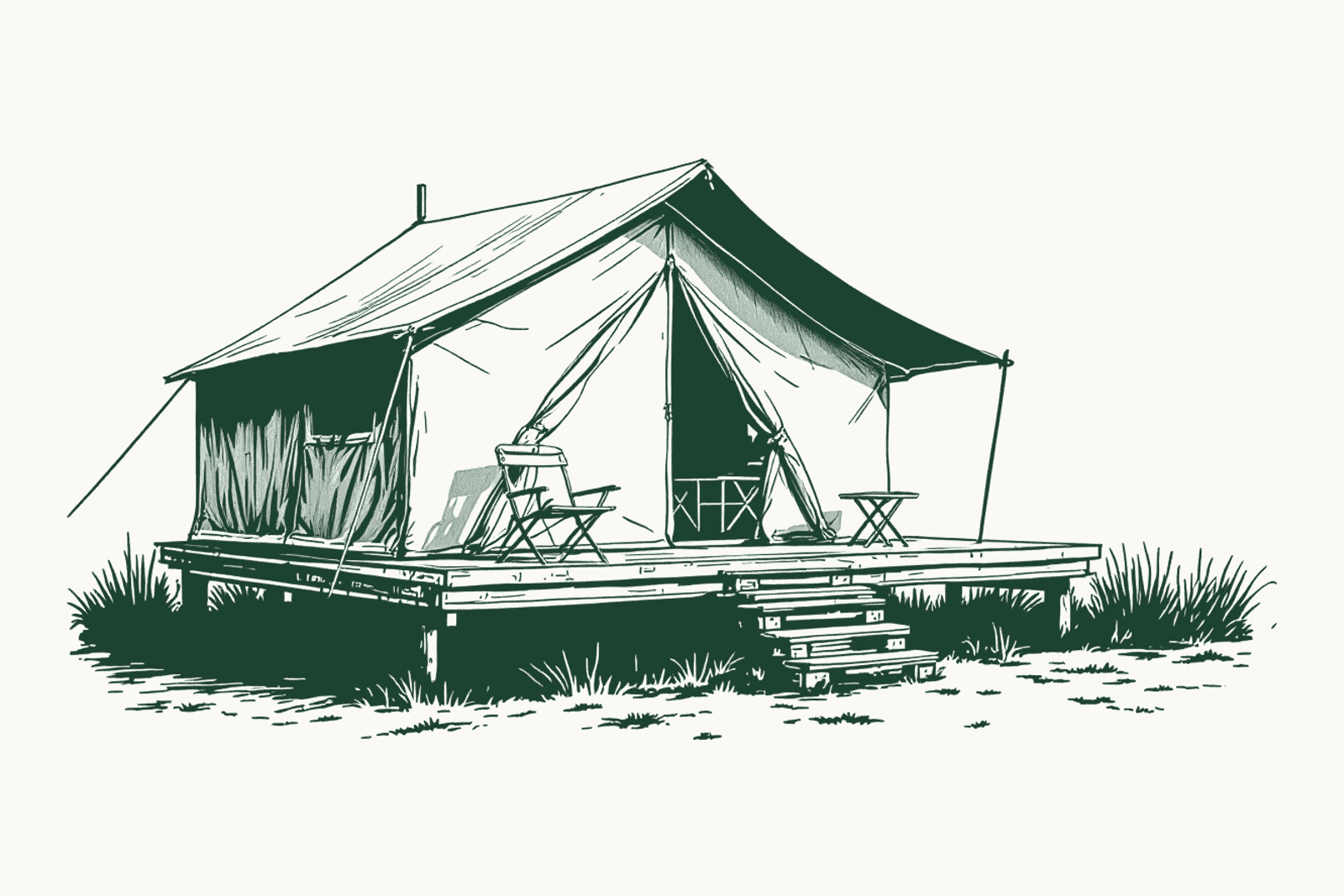
The booking photo shows a double bed with a wool blanket, a pendant bulb over a small kitchen counter, and canvas walls in the background. That is glamping: accommodation in a fixed, furnished structure on a campsite — a safari tent, a lodge tent, a cabin, a yurt, a pod — where you turn up with a suitcase rather than equipment. It is not a more comfortable way of camping. It is a different holiday that happens to take place on the same ground.
The name causes the confusion — “camping” plus “glamour”, as if glamping were just camping with the rough edges sanded off. In practice, the only thing it shares with a tent pitch is the postcode.
What the word actually covers
“Glamping” is not a standard; it is a marketing word, and the gap between two places carrying that label can be enormous. The common ground is short: a fixed structure put up for the season or the year, a real bed rather than a mattress on a groundsheet, a floor, mains electricity. Past that point, everything varies. Some places add a full kitchen and a private bathroom; others amount to two electric rings and a shared water point fifty metres away. A well-insulated, heated lodge can be booked comfortably in November; a single-skin safari tent can turn miserable the moment nights drop below 10 °C.
That variability is not a footnote — it is the single most useful thing to know before booking. The listing description matters more than the word “glamping” itself. Check exactly what is provided — bedding, towels, a fridge, private or shared facilities — before you go, rather than trusting the label to tell you.
Head-to-head with a tent and a pitch
On the ground, the comparison runs along five axes rather than one overall verdict.
Cost, first: a night in glamping accommodation is structurally more expensive than a bare pitch, because the price carries the depreciation of a permanent structure and its furniture. That is not a minor add-on; it is the basic gap between the two models.
What you need to own, next. With a tent, you buy it, store it, and pitch it — the criteria that actually matter are set out in how to choose a camping tent. In glamping, the structure belongs to the site; you need no sleeping or shelter kit of your own.
Set-up time: pitching a tent takes anywhere from five minutes to half an hour depending on the model; glamping accommodation is ready the moment you arrive, which matters a great deal on a wet or late-night arrival.
Weather tolerance, which is the heart of it: a tent puts you a single layer of fabric from the weather outside. Glamping puts you a wall from it. That is exactly the appeal on a night of driving rain or wind — and exactly the loss. You stop hearing the rain, stop feeling the cold morning air come through the canvas, and end up with simply a room, elsewhere.
Freedom to move, last: a tent travels, folds down, and goes up wherever the site allows. Glamping accommodation is fixed by nature; there is no touring version of it.
| Criterion | Pitch + tent | Glamping accommodation |
|---|---|---|
| Kit you need to own | Tent, mattress, sleeping bag, cooking gear | None — just personal belongings |
| Set-up time | 5–30 minutes to pitch | Ready the moment you arrive |
| Weather | One layer of fabric between you and the outside | A wall between you and the outside |
| Cost | The lowest, once the kit is bought | Structurally higher |
| Freedom to move | Full — pack up and go | None — the structure is fixed |
What you still need to pack
Booking glamping accommodation does not excuse you from packing a bag, and the classic trap is bedding. Many rentals charge extra for sheets and towels, or do not supply them at all — the listing rarely spells this out clearly, and it is worth asking before you travel rather than finding out at 10pm on arrival.
The rest of the list looks like any camping packing list, just shorter. A head torch or lantern for the walk to the shower block or between accommodation units, since the lighting inside a lodge never reaches the path outside. A cool box if the kitchenette has no fridge, which is common in the simpler set-ups. Cooking kit beyond the basics if the kitchen is two electric rings and nothing else — the most usual case — since a saucepan and a frying pan are not always provided. And the same wet-weather clothing you would pack for any stay outdoors, since the comfort of the lodge stops at its own front door. A standard camping checklist is a good starting point to trim down according to what the accommodation actually supplies — see the camping gear checklist and, more broadly, what gear you need for camping.
Who it genuinely suits
Glamping answers specific situations rather than a type of holidaymaker.
A first trip with young children, where the point is to test the rhythm of a campsite — cooking outdoors, shared facilities, communal living — without adding the challenge of pitching a tent and cold nights on a thin mat. Family camping gear covers what actually matters in that situation, kit included.
A group with mismatched enthusiasm, where one person wants comfort and another would happily rough it: glamping settles the argument by putting everyone on the same site, each in the accommodation that suits them.
A shoulder-season stay, in April or October, when nights easily drop below 8 °C and even a well-chosen sleeping bag — see how to choose a sleeping bag — asks for a level of commitment not everyone wants to make.
And, more simply, anyone with no camping equipment at all who wants to find out whether they like the basic idea of a campsite — the pitch, the shared facilities, meals cooked outdoors — before investing in a tent that might end up unused in a cupboard.
Who should take a tent instead
Glamping costs you your mobility and part of your contact with the outdoors; anyone after precisely those two things is better off with a tent. Anyone who wants to move from site to site during a trip, or change region overnight, cannot do that in a fixed structure. Anyone counting the pounds will see the price gap repeat every night, while the cost of tent kit is spread over years of trips. And anyone who goes camping specifically to sleep outdoors — hearing rain on the flysheet, feeling the temperature drop through the night, waking up to condensation on the inner tent — loses the point of it by sleeping behind a wall instead.
One question settles it before you book: are you after a campsite, or are you after camping? If the answer is the campsite — the atmosphere, the communal life, access to the outdoors without owning the kit for it — glamping delivers exactly what it promises. If the answer is camping itself, keep the tent, and put the difference in price towards a better sleeping bag.
Frequently asked questions
- Does glamping accommodation always include bedding and towels?
- No, and it is the most common mistake. Many places charge extra for bedding or do not supply it at all, and the listing does not always make this clear. Check this point before booking rather than finding out on arrival.
- Can you go glamping in cold weather?
- It depends entirely on the type of structure. An insulated, heated lodge can be booked comfortably all year round; a single-skin safari tent, often unheated, becomes uncomfortable once nights drop below 10 °C. The word 'glamping' says nothing about this difference — only the accommodation description does.
- Is glamping cheaper than a hotel near a campsite?
- Not necessarily, and it is not really the right comparison. Glamping compares to a tent pitch, against which it is structurally more expensive because the price covers the cost and upkeep of a permanent structure. Against a hotel, the difference depends mostly on location and season, and does not run one way as a rule.
- Do you need to bring cooking kit for glamping?
- Often a minimum, yes. Many kitchenettes amount to two electric rings, with no saucepan or frying pan supplied. A cool box is also worth packing if the accommodation has no fridge, which remains common in the simpler set-ups.