Cooking
Barbecues and griddles at a campsite: what can you take?
Charcoal, gas or a flat griddle: what campsite rules allow, what the fat does differently on each, and how you clean up with no hot water on the pitch.
6 min read
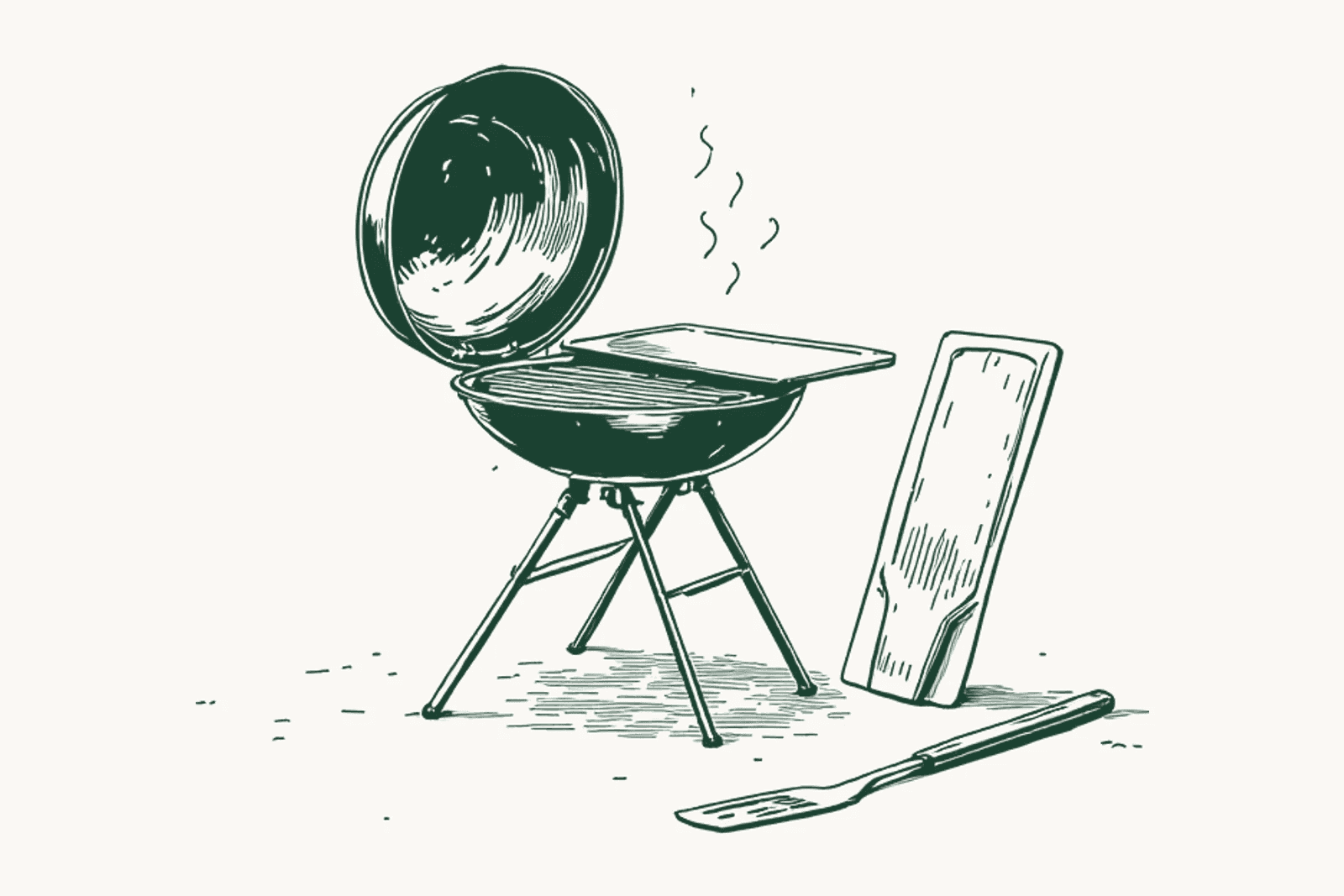
The decision is not made in the shop. It is made in the campsite rules. Plenty of sites forbid charcoal on individual pitches — embers that travel, hot ash in the bins, smoke drifting across three plots — and accept gas without a second thought. Start there: a charcoal barbecue bought for the summer can easily spend three weeks in the boot. The second decision comes down to one word, fat. On a grill it drops onto the heat source and flares; on a flat griddle it stays on the plate and wipes off. Almost everything else follows from that.
What the site allows, before what you prefer
The site rules are pinned up at reception and usually published online next to the prices. That is the document to read before buying, not on arrival. Three wordings come up again and again: no charcoal on pitches, barbecues permitted only in a communal area, or gas appliances only. A site that says nothing at all about it is rare, and a phone call settles the question in thirty seconds — the same call that covers the other checks in how to choose a campsite.
A second rule sits on top of the first, and it is not the manager’s to make. In France, lighting a fire near woods, forest or heathland is forbidden to anyone other than the landowner, and prefectures tighten that ban by order during dry spells — sometimes overnight, across a whole department. A site in a pine wood can therefore allow barbecues in June and ban them in August without changing a word of its own rules. Other countries handle this differently; wherever you are, the local fire restrictions are worth checking alongside the site’s.
Charcoal, gas, electric: three different constraints
The fuel matters less for flavour than for three practical questions: how long before you can cook, what happens to the waste, and what energy you actually have on the pitch.
Charcoal needs twenty to thirty minutes between lighting and usable embers, and leaves ash that stays hot far longer than it looks. It is the most demanding option at a campsite, and the only one that gives that particular flavour.
Gas is ready in two minutes, adjusts at the valve and stops dead — a quality worth more than it sounds when a child is circling the table. One small cylinder runs a grill or a griddle equally well, and the reasoning matches that of a camping stove: fuel availability counts as much as the appliance.
Electric only arises on a hook-up pitch, and runs into a limit the brochures skip: a pitch is often rated at 6 or 10 amps, roughly 1 400 or 2 300 watts for everything you plug in at once. A 2 000-watt grill takes almost the whole supply, and the neighbour’s kettle is enough to trip the shared breaker.
| Type | Ready to cook | Cleaning | What it does best |
|---|---|---|---|
| Charcoal | 20 to 30 min | Messiest, ash to dispose of | Large cuts, smoky flavour |
| Gas, grill | 2 to 3 min | Grill bars degreased cold | Meat, sausages, kebabs |
| Gas, griddle | 8 to 10 min | Deglazed with water while hot | Fish, vegetables, a whole meal |
| Electric | 5 min | Removable plate, often washable | Pitches with a hook-up |
What the plate changes
A grill cooks by direct radiant heat, and the fat that falls ignites, producing both the flavour people want and the classic barbecue failure: the outside blackened before the inside is done. A griddle cooks by conduction on a solid plate; the fat stays on it, nothing flares, and the temperature depends on the mass of metal rather than on the flames.
That mass explains the two differences that matter when camping. The plate takes longer to come up to temperature — eight to ten minutes against two or three for a grill — but once hot it absorbs a fistful of cold food without collapsing, where a light grill loses its heat immediately. More to the point, it holds everything that would otherwise fall through: fish, courgettes, mushrooms, eggs, bread to warm. A camping griddle will produce a whole meal, which makes it far more versatile than a two-burner stove when there are several of you.
The honest trade-off: it is heavier for the same size, it wants a little fat where a grill wants none, and it will never give you the taste of charcoal.
Cleaning, the criterion nobody weighs
This is the line missing from every comparison, and the one that decides whether the thing gets used. On a pitch there is no hot tap, no sink, and no great quantity of washing-up liquid. A cold grill with baked-on fat means twenty minutes of scrubbing in cold water, crouched at the communal washing-up sinks, watched by people waiting their turn. A plate deglazed while hot takes three passes with a scraper, on the spot, while everyone is still finishing their plate.
The difference is not a detail: it decides whether the appliance comes out again on the second evening or stays in the boot. Two habits help in either case. Clean immediately, while the heat is doing the work for you; and never pour fat into a communal sink or washing-up trough — it sets in the pipes and the site finds it before you do. Fat goes onto kitchen paper, and kitchen paper goes in the bin. The rest of the camp kitchen, worktop and washing-up included, is covered in how to organise a camp kitchen.
Fire, smoke and the neighbours
Three rules, none of them negotiable.
A barbecue never comes inside the awning or the tent, even when it looks out. Embers that have stopped flaming still give off carbon monoxide for hours: a colourless, odourless gas that gives no warning before drowsiness, and that kills in an enclosed volume. The rule holds against the temptation to bring the thing in “just so it doesn’t get rained on”.
A spark does not set modern tent fabric alight; it perforates it. Polyester and nylon melt before they burn, and a barbecue two metres upwind of an awning leaves a constellation of pinholes that only announce themselves in the first downpour. Put the appliance downwind of the fabric — yours and next door’s.
Ash stays hot well beyond twenty-four hours and has no business in a campsite bin, where it has set fire to whole containers before now. Drown it in water, check by hand that it is cold, and only then throw it away.
What actually earns its place in the boot
A long metal scraper, because a short one cooks your hand before it cooks anything else. A chopping board kept for raw meat, stored apart in the cool box and never used for salad. A roll of foil, which rescues an undersized plate and doubles as a lid. And a metal container for the ash, if you have gone with charcoal.
That leaves the cheapest advice of all: cook a full meal on it in the garden or on the balcony before you go. That is where you discover that the plate takes twelve minutes to heat, that the regulator does not fit the cylinder you bought on the way, or that the legs will not stand up on anything but a patio — three discoveries that are considerably easier to handle at home than four hundred kilometres away, the evening before the first proper meal. The rest of what to pack is in the camping gear checklist.
Frequently asked questions
- Can you use a charcoal barbecue on a campsite pitch?
- It depends on the site rules, and many forbid it on individual pitches because of flying embers and hot ash; some provide a communal barbecue area instead. Gas is usually accepted without restriction. In France, prefectoral orders can also ban any fire near woodland during dry spells, whatever the site itself allows.
- Barbecue grill or flat griddle for camping?
- A griddle if you cook varied food and dislike scrubbing: the solid plate takes fish, vegetables and eggs, and deglazes with a splash of water in seconds. A grill if you mostly cook large cuts and want the flavour that comes from fat dripping onto the heat source.
- Can you bring a barbecue inside the awning or the tent?
- Never, even when it looks out. Embers that have stopped flaming still give off carbon monoxide for hours, and the gas is colourless, odourless and lethal in an enclosed space. A barbecue cools down outside, well away from any fabric.
- How do you clean a griddle with no hot water on the pitch?
- While it is still hot: a splash of cold water on the hot plate turns to steam and lifts the residue, which a scraper gathers up in a few passes. Wait until it has cooled completely and the same job becomes twenty minutes of scrubbing in cold water.