Motorhome
Campsite electricity: what can you plug in on 6 A or 10 A?
A kettle and a hair dryer together on 6 A? No. What the amps on your pitch actually mean, and what you can run without tripping the breaker.
4 min read
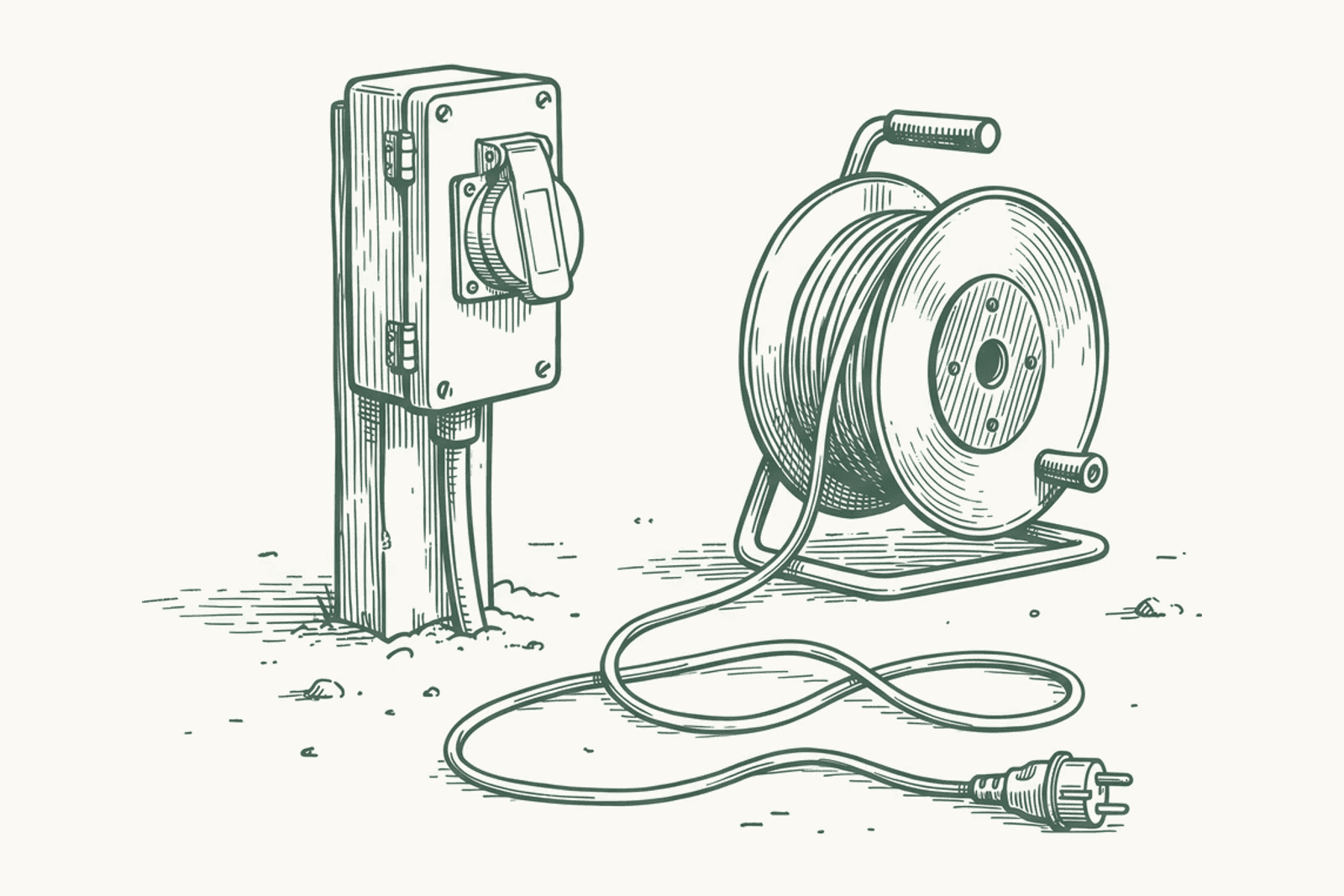
A campsite lists your pitch as “6 A”, and the 2,200 W kettle you tucked into the boot will not run on it, even by itself. The rule is short: available power is roughly 230 V multiplied by the amps. That gives about 1,400 W on 6 A, 2,300 W on 10 A and 3,600 W on 16 A — for everything running at the same time, not appliance by appliance. Go past it and the breaker trips. To do the sum without a calculator, the campsite electricity calculator lets you tick the appliances you plan to use, pick 6, 10 or 16 A and see whether it holds.
What eats the amps
What counts is not the size of an appliance but what it does with the electricity. Anything that produces heat — kettle, hair dryer, fan heater, grill, induction plate, toaster — draws between 800 and 2,300 W. Anything that computes, lights or cools gently is counted in tens of watts. One appliance from the first group outweighs ten from the second.
| Appliance | Typical power |
|---|---|
| Kettle | 1,500–2,200 W |
| Low-power travel kettle | 600–1,000 W |
| Hair dryer | 1,200–2,000 W |
| Fan heater | 2,000 W (1,000 W on its low setting) |
| Electric grill or plancha | 1,500–2,300 W |
| Induction plate | 1,500–2,000 W |
| Coffee machine | 1,000–1,500 W |
| Toaster | 800–1,000 W |
| Peltier cool box | 40–60 W |
| Compressor cool box | 40–80 W while running |
| LED lighting | under 20 W |
| Phone charger | under 20 W |
| Laptop | 45–90 W |
These are orders of magnitude. The rating plate on the appliance is the figure to trust — a frugal model or a thirsty one can sit well outside these ranges.
Counting what runs together
On 6 A, or 1,400 W: an 800 W travel kettle, a charger and two LED lamps sit comfortably. Swap the kettle for a 2,200 W model and the breaker goes in the first second. On 10 A, or 2,300 W, a standard kettle runs alone; add a hair dryer and the total reaches 3,500 W.
The remedy is not hardware but sequence. Boil the water, then leave it, then start the heater. Breakfast and hair drying do not overlap. That is why travel kettles of 600 to 1,000 W exist: they heat more slowly but stay compatible with everything else. The trade is plain — time against headroom.
Electric cool boxes deserve honest counting. A compressor or Peltier model stays under 80 W, but it runs for hours; if you are weighing the two technologies, our guide to cool boxes sets out what each costs in comfort and energy. Electric grills, for their part, brush the 10 A limit on their own, as the piece on barbecues and planchas at the campsite points out.
When it trips
A tripping breaker is doing its job: protecting the cable and the bollard’s wiring. It is often in the bollard itself, sometimes shared with the neighbouring pitch. In that case their consumption counts as much as yours, and getting power back may mean asking reception. Unplug the large appliances first, restore the supply, then plug them back in one at a time.
If it keeps happening, do not look for a “stronger” breaker: the threshold is the bollard’s, not your kit’s.
The cable, the plug and the damp
An indoor extension has no place outdoors. You want an H07RN-F type cable, rubber-sheathed and rated for outdoor use, in 2.5 mm² once the distance passes a few metres; 25 m is a common length. The longer and thinner the cable, the more it heats under load.
Even a good cable is unrolled completely, to the last turn on the reel. Coiled, it stops shedding heat; under 2,000 W the inner turns can soften before anything cuts out.
At the bollard, most French and European installations use the blue CEE 17 socket, known as P17. A lead with that plug, or an adapter to a household socket, belongs in the basic kit. Keep connections raised, off wet grass and puddles; a waterproof cover over the join adds protection against rain. The bollard should have residual-current protection (usually 30 mA): if it trips in damp weather, look for the leak rather than bypassing it.
Check before you book
The amperage appears on the pitch description or in the booking terms, and it varies from site to site — 6 A is common, 10 A rarer, 16 A reserved for certain pitches. Better to know before buying a heater or kettle than to discover it on the first evening. Our guide to choosing a campsite lists this among the things to check when booking.
Before you leave, tick your appliances in the electricity calculator, counting only what you will really use at once. The result will tell you whether you need a gentler kettle, a two-setting heater, or simply a better-equipped pitch.
Frequently asked questions
- Can you plug a heater into a 6 A pitch?
- Yes, but more or less on its own. A 2,000 W fan heater exceeds the 1,400 W that 6 A allows, so it has to go on its low setting, often 1,000 W, with nothing else heating at the same time. On 10 A it runs at full power, leaving around 300 W for lighting and chargers.
- Why must a cable reel be fully unrolled?
- Because a coiled cable under load cannot shed its heat: the turns warm one another, and the sheath can soften or even melt well before the breaker reacts. Unrolled, the same cable gives its heat up to the open air. With anything over 1,000 W, unroll it all, even for a three-metre run.
- Which plug does a campsite bollard take?
- Most French and European bollards take a blue CEE 17 plug (known as P17), built to EN 60309. You need an extension lead with that plug on the bollard end and a household socket on the appliance end. If you only own an ordinary extension, a CEE 17 to household-socket adapter is the accessory to add.